That is a bad approach — and a misuse of scarce resources.
Skip to the end of this long post for comments for City Council members which you are welcome to use in your own email or public comment to request that they (1) fully remove hypothetical Alameda-specific e-bike regulations from Council's Strategic Plan for 2026; (2) instead support state-level regulation of the marketing and sale of electric motorcycles; and (3) continue to prioritize Alameda's Vision Zero Action Plan to lower the odds of transportation-related deaths and severe injuries, which are primarily caused by drivers of cars, SUVs, and trucks.
Dear teens of Alameda,
Some of you probably would have enjoyed my birthday party when we took my parents' rolling office chairs, pushed them up to the top of my steep street, and repeatedly rode them, hooting and hollering, down to the bottom of the hill.
But you probably wouldn't have enjoyed one of my other birthday parties, which ended in a trip to the emergency room. We had all gone around the neighborhood for a bike ride, two of us got our wheels entangled, and I flew over my handlebars and onto the pavement. That school year sucked, as I nursed a broken shoulder. (Then again, I wasn't a middle-school girl, so comparatively speaking, I probably still had an easier year of 7th grade.)
Before I also start reminiscing about "LAN parties," maybe you all should just pass this over to your parents...
Dear parents of teens of Alameda,
Consumer-product regulators are failing you. Amazon and other online merchants are failing you. And politicians throughout the more affluent suburbs of the state — and now in Alameda — are getting ready to have armed police officers give stern lectures to your kids, possibly after chasing them at speed. The kind of stern lectures that feel edifying to those adults, while being somewhere between useless and completely counter-productive for the actual kids in question.
Over the last year, I've chatted with some of you one-on-one about your families' experiences with teenagers and "e-bikes." [More on what an "e-bike" is — and isn't — later in this blog post.] I've appreciated the range of comments and concerns I've heard. Like any aspect of being a parent, it's complicated: appreciating when teens entertain themselves and get around by themselves, balancing freedom with safety, being hounded to buy the latest trendy toy, and worrying about the influence of peers...
In these conversations, some themes have emerged that might inform a wider public conversation (and perhaps public policy). But more importantly, it's been helpful to just learn about day-to-day life and routines for various families and teens across Alameda.
Because that's been one of the more humbling aspects I've found of becoming a parent: finding how much things change from year to year. I have one kid currently in first grade and one kid currently in fourth grade — and that means I'm eminently unqualified to guess what a morning route on a school-day is like for a seventh grader and their parents!
If you have a middle schooler, can you finally ask them to make their own breakfast? Do you get them to school, or do they get there themselves? What about after-care programs — are those still even a thing in middle school? And for high schoolers in Alameda, where are they going in the afternoon to do their homework, or their bazillion extracurricular or athletics or whatever? Is your teen taking driving lessons? If they already have their license, what kind of car are they driving — your big spare SUV you used to only use to drive up to Tahoe, or something more appropriately sized for Alameda streets? When chatting one-on-one, those of us without teens are able to understand more of that context.
In contrast, adults posting to social media or writing letters to the editor are bypassing that context and jumping right to freaking out about teens — maybe your very own children! — dangerously whizzing down street on these new "e-bikes." (Let's pause to note that to my knowledge, none of the five current members of Alameda City Council have teenage children.)
With all that said, here's the crux of the problem:
- some of these "e-bikes" are bicycles where a battery and a motor provide a boost that eases a cyclist's trip (making it easier to hop on and reach a destination, with less sweat)
- some of these "e-bikes" would be more accurately described as electrically powered motorcycles
While my parents let me and my friends ride those chairs down the steep street, and my parents let me become independent pedaling my bike ~4 miles to the public library and ~8 miles to the Stanford campus, my dad also told me about his experiences as a young adult on a motorcycle and how he had quit completely after falling from it in a construction zone with uneven pavement. He showed me the scars, and that is something I internalized viscerally: a motorcycle is much too dangerous.
This is typically the point when writing about this topic when a newspaper columnist or a police lieutenant or a school-district administrator will introduce Class I and Class II and Class III e-bikes... but we're not going to waste our time on that in this blog post.
That classification system is broken. It doesn't cover and explain the full range of products available via the internet to you — and available to the parents of your kids' friends. It doesn't account for after-market hacking that teens can learn from TikTok (or even straight from some manufacturers' own smartphone apps). Plus the Class I/II/III e-bike stuff is boring. If we get into those details, we'll lose sight of the reality.
For now let's quote from a recent SF Chronicle article:
One reason for the proliferation is that e-bikes, legal and otherwise, are getting less expensive. In 2022, consumers spent an average of $2,600 for commuter and leisure e-bikes, according to a white paper by researchers from Portland (Ore.) State University. But those costs went down as cheaper versions of e-bikes flooded Amazon. One best-selling electric bicycle with a 1,500-watt motor, and a vaunted top speed of 28 mph was selling recently for $800.
“This used to be a rich kids problem,” [a retired lawyer turned safety advocate] said, “and now it’s not.”
Perhaps it's one of those $800 overly zippy devices that Councilmember Tony Daysog saw when he's repeatedly remarked in Council meetings about seeing teens — maybe your teens? — going much too quickly through Krusi Park. That's what he says compelled him to file a referral to ban "e-bikes" from the city's parks and trails late last year.
As part of their annual priority setting workshop in January, City Council members took a straw poll on various issues. I rode my own Class I e-bike over to the school district offices where they were holding the workshop, and observed while they held their thumbs up — or gave a thumbs down — to their facilitator from the Piedmont City Council.
They didn't even have to raise their thumbs regarding Councilmember Daysog's proposal to "regulate" "e-bikes" because in advance all five councilmembers had marked on ballots general agreement with that as a proposed new project.
For the City Council's goal of Invest in Transportation, Infrastructure, Economic Opportunities, & Historic Resources, almost all of it concerns "e-bike safety measures" for the entire year:
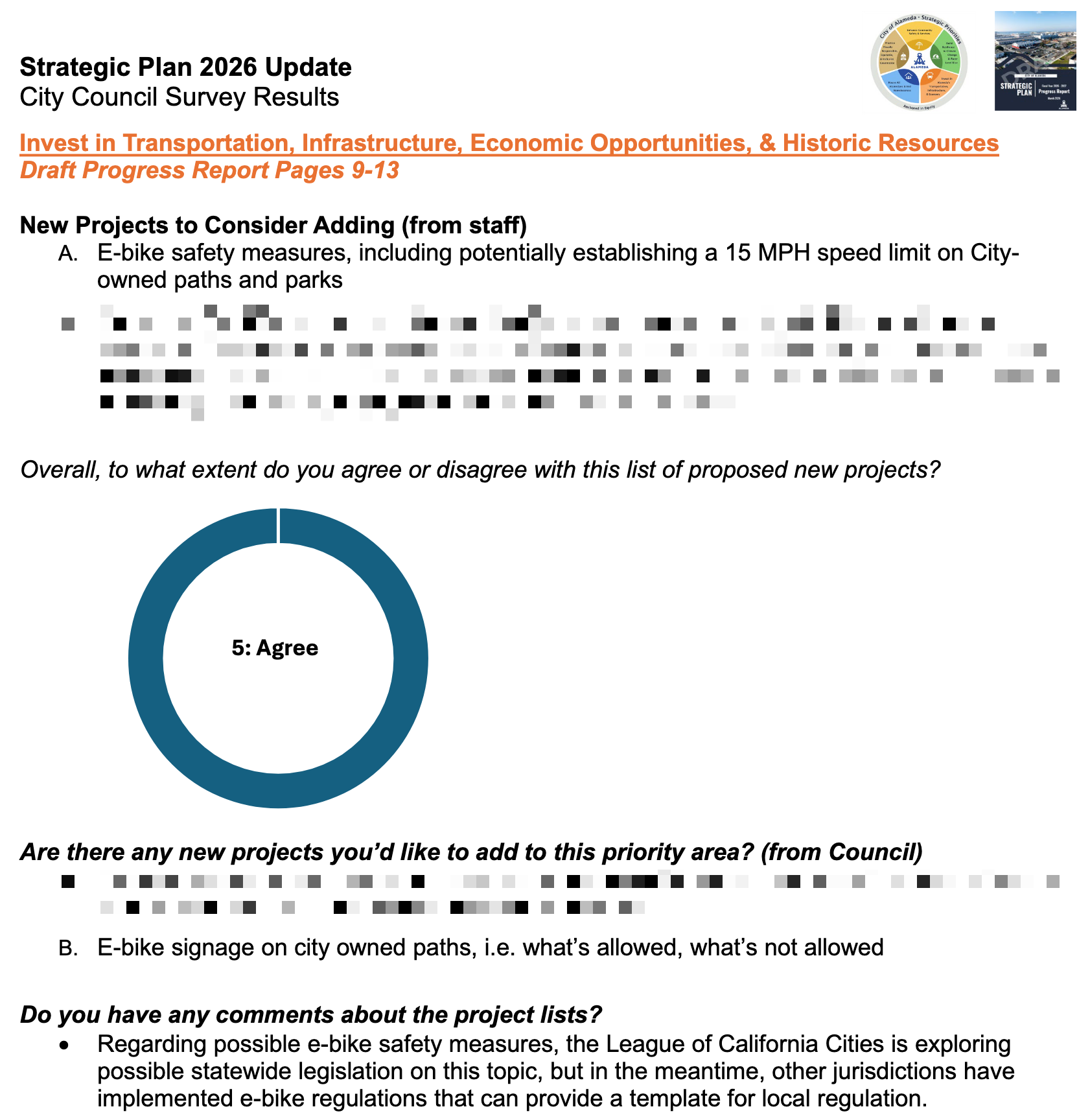
Councilmembers think that writing new regulations (perhaps along with signage) is the most important new transportation topic in the city. But is it really?
If I take Councilmember Daysog's perspective and look at Krusi Park purely from the perspective of rules, I see much more "lawbreaking" than teens on battery powered devices:
- I see an unsanctioned off-leash dog park. Despite AMC 23-2.2, many people bring their large dogs to frolic together on the playing fields. One time a large off-leash dog interfered so much with my daughter's softball game that the umpire halted the game and the coaches had to shout at the dog's owner.
- The unofficial dog park continues even when the fields are closed to softball and baseball players because of wet weather. As I walked past Krusi Park earlier this winter, the dogs were often all running around in the mud surrounding an ARPD sandwich board sign marking the fields as closed (to protect the turf).
- When my kids and I walk along Krusi Park in the morning, I also see cyclists breaking the law. Not teens on battery powered devices. Rather it's parents who are bringing their kids to Otis Elementary School in trailers. Alameda Bicycle or REI will gladly sell you a nice looking Burley bike trailer that has been tested and certified as safe for transporting your kid — but sorry, parents, it's illegal to place your child in a bike trailer per AMC 11-4.8. It's only legal to use a bike trailer to carry newspapers (presumably on your olden-time'y newspaper delivery route). City of Alameda has been informed of this out-dated provision by Bike East Bay staff over the years, but no one has ever updated the code.
Given all of the violations of Alameda Municipal Code in Krusi Park alone, why should City Council even be considering adding yet more AMC provisions to address "e-bike safety"?
There is one single APD officer assigned to traffic enforcement. (Up from zero!) Is that officer also going to now be responsible for monitoring teens after school in Krusi Park? How from a distance will he tell the difference between Class I, Class II, and Class III e-bikes as well as e-motos? If he can't tell from a distance, how will he approach and determine the device type? If a teen gets spooked and zips off, will he follow?
These aren't hypotheticals. Police are now chasing kids on electric bike and motorcycle devices. (Most of the situations appear to be around the L.A. region so far.)
And if APD officers aren't going to be equipped to enforce new municipal code provisions in Krusi Park, then why even adopt new code provisions?
And how will APD officers enforce these potential provisions along the Bay Farm mixed-use trail or the Cross Alameda Trail's distinct cycling and walking lanes? Will they stop adults cycling to the ferries in the morning to check the class of their e-bike?
Some elected officials may want to get ahead by looking tough on young scofflaws — but instead they're opening a whole lot of complicated questions. (They're likely not going to get tough on the adults with their off-leash dogs, because those adults can vote for City Council elections.) These questions like how APD officers should check riders' e-bike classes take us all further and further away from what actually matters.
As a parent and as a member of the city's Transportation Commission, I think these are the two goals that actually matter:
- Continuing to focus Alameda's traffic safety enforcement on drivers. Drivers of cars, SUVs, and trucks continue to be the biggest threat to safety on Alameda's streets. Distracted drivers, as well as drunk drivers, are responsible for all recent fatalities of pedestrians, cyclists, and vehicle occupants.
- Supporting state-wide efforts to stop the sale of e-motos to minors and to properly regulate their usage by adults. With the State of California having the ability to interrupt the marketing and sale of overpowered e-motos, then you will be able to better trust the options online and in stores if you decide to buy a street legal Class I/II e-bike for your own teen or a Class I/II/III e-bike for yourself (and for other adults who use these to commute or to perform delivery work). Perhaps even more importantly, the odds that one of your teen's friends will get an overpowered e-moto will go down with proper state-level legislation.
Instead of having 5 out of 5 councilmembers expressing an interest in crafting bespoke e-bike regulations for the Alameda Municipal Code, I wish we had councilmembers speaking to the importance of focusing enforcement efforts on those of us who drive cars, SUVs, and trucks. (I include myself in that group deserving of enforcement, as besides an e-bike, I drive a Subaru station wagon.)
Instead of having councilmembers referencing the League of California Cities (an organization whose prerogative is to always maximize local control), I wish we had councilmembers pointing to the state as the right venue and to legislation as the right tool to systematically address the problem of "e-moto" electric motorcycles and dirt-bikes. The only thing more useless than adding more clauses to the Alameda Municipal Code would be to copy random language from another city or town into the Alameda Municipal Code.
Like all aspects of raising kids, there's so much more to this topic — and I would welcome any other parents who want to shoot me an email or tell me over coffee about their experiences with teens and e-bikes and e-motos. But concerning the involvement of City of Alameda in e-bike and e-moto regulation, I think City Council would do well to take a deep breath — and then remove from this year's Strategic Plan their proposed goals related to "e-bike safety measures."
Dear Mayor, Vice Mayor, and Councilmembers,
At Tuesday March 17's City Council meeting you'll be receiving the city's annual report on transportation. It demonstrates how many improvements the city's comparatively small staff accomplishes each year.
The annual report also demonstrates both progress and problems with traffic safety. Only a single fatality, which represents a meaningful improvement from previous years of multiple fatalities. However that pedestrian was killed by a driver at the same intersection at which another driver killed another pedestrian just a few years ago. (The intersection has not received any substantive changes since the previous crash.) That is an example of the sort of pernicious traffic safety problems that City staff and City Council must continue to direct time, attention, and budget toward solving.
However, the Strategic Plan that Council adopted in January is instead directing resources toward potentially wide ranging "e-bike safety measures."
Having APD officers check the e-bike classification of students in parks and ferry commuters on trails would be a huge distraction from more impactful causes of traffic dangers. And if you aren't proposing to have APD officers actually checking individual bikes, then are you just aiming to add clauses to the Alameda Municipal Code that will never actually be enforced?
Overpowered electric devices are a genuine problem. But to succeed, regulations need to be adopted at the appropriate level and involve all of the relevant stakeholders. If you want to take meaningful action on this topic, please direct city staff and the city's lobbying firm to support the following proposed legislation:
- Senate Bill 1167, a bill co-sponsored by the California Bicycle Coalition that cracks down on the deceptive marketing and labeling of overpowered electric motorcycles as "e-bikes."
- Assembly Bill 1557, a bill which "clarifies that the 750-watt limit applies to maximum motor power. The bill does not ban e-bikes or target responsible riders. It simply draws a clear, enforceable line between an electric bicycle and a motorized vehicle."
Carefully crafted solutions are needed at the state level to stop the sale of "e-moto" motorcycles and electric dirt-bikes to uninformed parents or directly to minors — that's exactly what's recommended in a recent report on e-bike safety from San Jose State's Mineta Transportation Institute. (That report was prepared at the direction of the state legislature to inform further state-wide legislative solutions.)
But as for the City of Alameda's finite resources for policy-making and for traffic enforcement, please keep staff and policies focused on what really matters most here: enforcement to ensure responsible driving by those behind the wheels of cars, SUVs, and trucks.
If councilmembers want to meet real kids on real bikes and see how safety training can be positive (rather than punitive), join the Alameda Bike Festival on May 5.
Unfortunately the city's bike safety workshops for 5th graders have been quite underutilized recently and this year's transportation report mentions that the program is temporarily being put on hiatus. Councilmembers who want to support educational solutions may want to ask if staff have ideas for how to adjust and restart this program in the future.
Alameda already has many of the most important tools for tackling traffic safety here — it's just a matter of making sure there's continued budget and time for staff, and a productive but not overwhelming amount of input from all of us members of the public.
Please remove the proposed "e-bike safety measures" from this year's Council Strategic Plan, support state-level solutions, and continue to fund and focus on the critical goals and programs of Alameda's Vision Zero Action Plan.