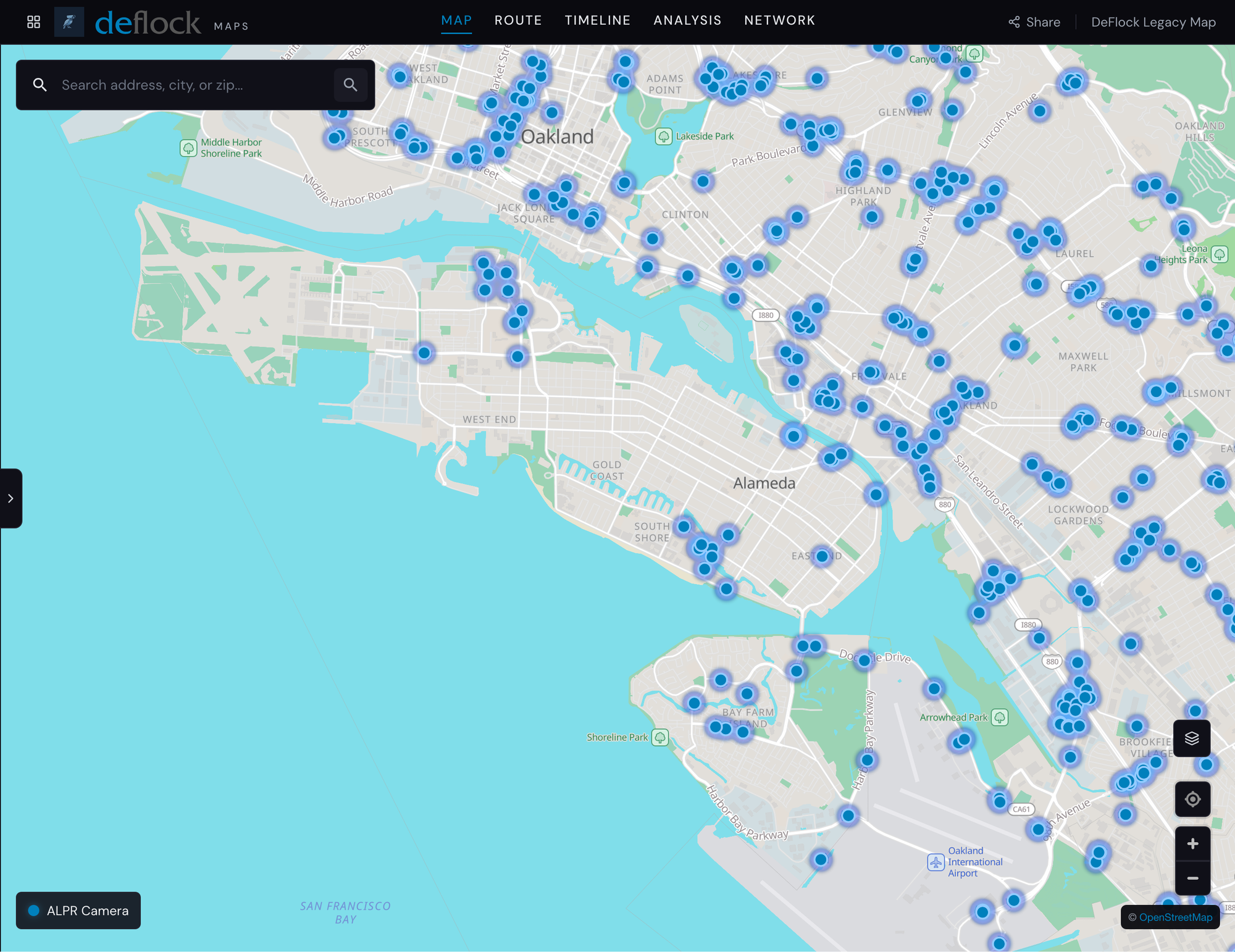
Since first selling automated license plate readers to homeowners associations in Florida, Flock Safety has been vigorously executing the playbook to scale a venture-backed tech startup. The company's black posts topped by cloud-connected cameras and small solar panels are now an almost omnipresent feature as you drive around the greater Bay Area. City of Alameda has a contract with Flock Safety, as do some of the HOAs in Alameda:
Seamlessness
The ubiquity of Flock Safety cameras is the strength of the offering: If an alleged kidnapper drives across jurisdictional boundaries, law enforcement personnel can use a single system to gather near-real-time evidence. If a stolen vehicle is detected far afield, law enforcement personnel can be informed quickly enough to potentially act on that information.
But also, now under the Trump/Miller/Musk administration, "seamless" tracking of public movements for "law enforcement" rings quite differently.
Here's a representative example reported earlier this month by 404 Media: license plates scanned on an Ohio public university campus were accessed by Florida’s Fish and Wildlife Conservation Commission police, who were performing the searches at the request of federal Immigration and Customs Enforcement officers. When Ball State University signed up for some Flock Safety cameras (perhaps in an effort to respond to local auto thefts) did they know they were simultaneously signing up for ICE to perform nationwide searches?
Another example reported last year by 404 Media is summarized by its headline: "A Texas Cop Searched License Plate Cameras Nationwide for a Woman Who Got an Abortion."
Leaving aside dystopian headlines, Flock Safety has also been documented with poor platform security practices. Earlier this year a researcher found exposed credentials to the geographic information system with positions and metadata for all of Flock Safety customers' physical assets, as well as investigative information like the "hotlists" for which vehicles are being sought by law-enforcement users. Cybersecurity is genuinely hard — and it's getting harder — but if their business is law enforcement, then software and data security practices should be foundational to their entire approach to developing, testing, deploying, and operating their software.
In Alameda
Who exactly has access to the information collected by the cameras installed under contract to the City of Alameda? (The cameras under contract to HOAs are another matter, although it does raise questions that some of them are pointed at public right-of-way leading to public destinations, without even a cursory audit by public agencies.)
This coming Tuesday's City Council meeting is an appropriate time to ask these sorts of questions because of two relevant agenda items:


The first agenda item is directly relevant, since it's Alameda Police Department's self-report about usage of the Flock Safety fixed ALPRs. This is the third time in as many years that APD has submitted this report to City Council. (Recently the City also added mobile ALPRs from Axon [neé Taser]; these are mounted on patrol cars and are not the topic of this blog post.)
The second agenda item is also relevant as a point of comparison: When pressed about the extreme downsides of one vendor (cough cough Tesla cough cough), Alameda promptly found another vendor to provide electric vehicles for the Alameda Police Department.
This blog post isn't about whether ALPRs are useful tools for the Alameda Police Department. This isn't even about whether ALPRs are a net-positive benefit when compared to their risks. (Those are questions worth asking, but they are also challenging to answer with empirical data and without becoming proxies for other bigger debates.) What this is precisely is a question of whether the City of Alameda can trust Flock Safety as a vendor for ALPRs.
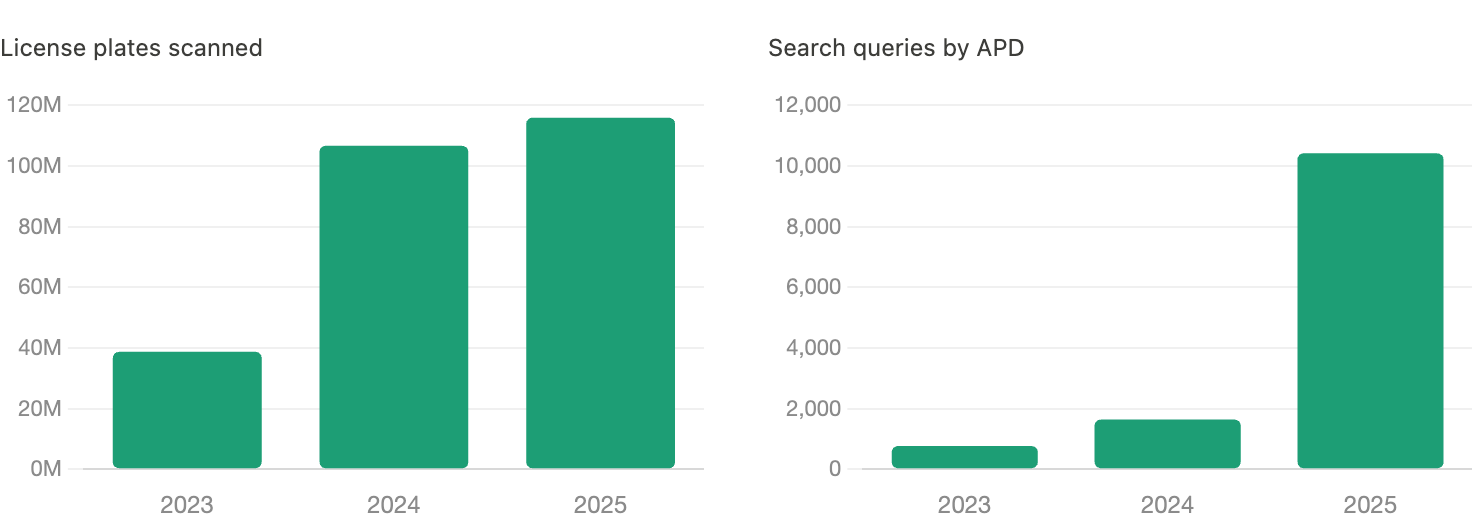
APD's comfort with the seamlessness of Flock Safety appears to grow across the three annual reports:
- In 2023, after other law enforcement agencies requested searches of Alameda's ALPR data, Alameda police "transferred the images from our automated license plate reader system into our digital evidence repository before sharing them. This allowed us to share the data without granting access to our automated license plate reader system"
- In 2024, zero "Authorized Agencies that access or received ALPR data."
- But in the latest report for 2025, "Authorized Agencies that access or received ALPR data" has grown to 14 unnamed agencies.
A nearby example: Mountain View
For the City of Mountain View, the answer to that question is no, Flock Safety cannot be trusted as a vendor.
In a letter earlier this year, Mountain View's police chief wrote:
Effective immediately, all Flock Safety ALPR cameras in Mountain View will be turned off.
[...]
I made this decision after careful consideration and deliberation. While the Flock Safety pilot program demonstrated clear value in enhancing our ability to protect our community and help us solve crimes, I personally no longer have confidence in this particular vendor. Like many of you, I was deeply disappointed to learn that Flock Safety did not meet the City's requirements regarding our data access control and transparency.
The existence of access by out of state agencies, without the City's awareness, that circumvented the protections we purposefully built and believed were in place is frankly unacceptable to me and to the dedicated people of the MVPD. Furthermore, this vendor's lack of proactive disclosure is inconsistent with the standards the MVPD holds and the assurances we were given by the Flock team. I, in turn, gave assurances to the community that I now know were not grounded in the Flock system's actual practice.
At a subsequent meeting, the Mountain View City Council terminated that city's contract for ALPRs with Flock Safety.
Another example: Capitola
Late last year, as reported by Santa Cruz Local:
Throughout 2024 and early 2025, federal and out-of-state law enforcement agencies searched Capitola Police Department’s database of automatic license plate readers more than three million times, violating multiple laws. At least 190 were done by sheriffs offices and police departments running searches on behalf of U.S. Immigrations and Customs Enforcement, or ICE.
Capitola Police have confirmed that they violated state law in sharing data with out-of-state agencies, and said the violations were unintentional
It sounds like how Capitola got itself into this "unintentional" situation was what user interface designers for consumer software products call a "dark pattern":
Legally, Capitola Police can only share data with other law enforcement agencies within California. But the department had opted into a tool offered by Flock that allowed Capitola Police to search license plate data nationwide —- and allowed out-of-state searches of Capitola’s own data, a Flock spokesperson said in a Nov. 7 email.
Doesn't this sound like a mistake you've probably made yourself on Spotify or LinkedIn? But when it's potentially a police department staffer pressing a button in a web app that is opting an entire city's worth of license plates to being exposed to ICE searches, that's a different matter.
One more example: Los Altos Hills
This one surprised me! While reading up on other cities in the greater Bay Area that have critically re-evaluated their relationship with Flock Safety, I found the Los Altos Town Crier's recent report that:
Los Altos Hills has decided to remove its Flock Safety automated license plate reader cameras around town, citing concerns about data privacy, cost considerations and overall effectiveness.
The City Council at its Jan. 15 meeting voted to direct city staff to begin the process of ending its contract with Flock Safety immediately for its 31 cameras around town.
The council removed the cameras due to concerns about Flock’s data privacy practices. These concerns related to U.S. Immigration and Customs Enforcement (ICE) having indirect access to automated license plate reader cameras (ALPR) data through Flock network searches conducted by state and local police agencies, despite there being no direct contract between ICE and Flock, according to a city staff report.
A couple years ago I blogged critically about how Los Altos Hills let its own residents opt out of ALPR tracking by specially registering their license plate numbers, since they figured no one who lived in that town could themselves be a criminal. Turns out they also care enough about their gardeners and service workers to now not want them also exposed to potentially insecure ALPRs.
And more seriously, the article does mention that the number of house robberies has recently decreased in Los Altos Hills, and town leaders think it's more to do with added private security than with the efficacy of ALPRs. They'd apparently now rather repurpose the money spent on ALPRs for other public-safety purposes.
A last local example: Alameda County
Two weeks ago, when a slight majority of county supervisors voted to temporarily continue Alameda County's contract with Flock, SFGATE reported that:
"I get the value of this, especially when it comes to search and rescue and just having drones, cameras, the technology," [county Supervisor Elisa] Marquez said. "But what I don't trust is this specific vendor, and they have a proven track record of violating our trust. I also am not at liberty to discuss confidential briefings, but with the information that I've been briefed on, I'm very, very worried about our vulnerabilities and the risk factors."
It is possible that the Sheriff's Office could find a different company to provide similar services once the now-extended Flock contract expires and the county issues a request for proposals in order to make the selection process more competitive.
Supervisors would then have the opportunity to draft contract language that more robustly protects the data from being accessed by outside entities.
What's in the contract Alameda signed with Flock?
After writing all of this, I figured I'd go back and look at Alameda's contract with Flock Safety.
I searched for the "National Lookup" tool, figuring maybe I'd find the legal terms that cities like Capitola unwittingly opted into. In the attached "Customer Implementation Guide," I did find a single mention of the National Lookup tool, pointing to a web-based FAQ:
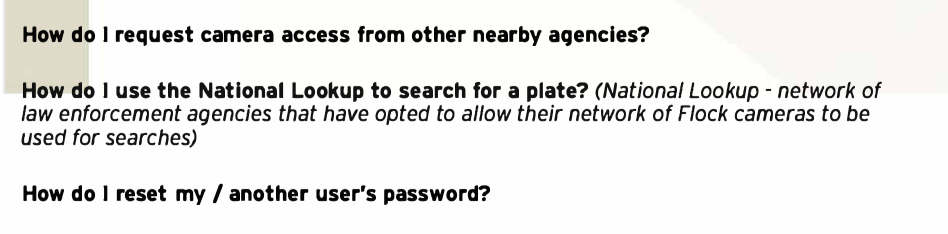
There's no mention that using this functionality will also opt your organization into sharing its own data. But also, there's no mention of this in the contract... because there appears to be no mention of data security, sharing, or ownership in the contract.
The City of Alameda's contract to purchase an ongoing subscription to a hardware/software service that collected personally identifiable information about the general public looks just like a template used for a professional services agreement — the kind of agreement the city might use to hire a consultant to deliver a written work product.
After some more looking, I found Flock's original proposal to Alameda, which also includes a Flock-written "services agreement order form" and a "government agency agreement." Were these referenced and executed as part of Alameda's contract package? If not, then the APD Policy Manual sets out these policies on data collection and retention but may have nothing to stand on contractually.
For instance, the APD Policy Manual sets a limit of 60 days for retention of ALPR records, with exceptions for records that become "evidence in a criminal, civil, and/or administrative action or is subject to a discovery request or other lawful action to produce records." The Flock Safety web app could allow a police administrator to dial in 60 days into a form, and it then limits users' access to all previous cloud-based records — but without mentioning that in the contract, then there's no actual enforcement mechanism to ensure Flock Safety follows through.
As another point of reference, Flock's public-facing terms and conditions currently grant Flock a:
limited, non-exclusive, royalty-free, irrevocable, perpetual, worldwide license to (a) use and disclose Customer Data to provide the Flock Services; and (b) use Customer Data to support and improve Flock’s products and services.
These are the kinds of terms that Facebook uses to maximize their own flexibility to train algorithms on all your selfies and all your uncle's posts. It's also from this legal flexibility around data ownership that all of a sudden a city can be surprised to learn that when their staff used a National Lookup search function a couple of years ago — which is part of the "Flock Service" after all — then Flock simply proceeded to "use and disclose Customer Data" to third-party agencies across the country. (The above terms and conditions are not explicitly referenced in the Alameda contract from 2022, but it's unclear if any other terms and conditions have been included via attachment or amendment.)
On the upside, Alameda Police Department has multiple staff engaged in preparing this annual audit — Alameda appears to be more proactive than some of the other jurisdictions who've found Flock challenging. At the same time, it's hard to actually determine which requirements of the APD Policy Manual on ALPRs are backed up by the current and complete vendor contract. If it's not written into a contract, then that policy is simply instructions to APD staff to enter user-facing settings into a software system and data platform that's effectively out of the City's control.
Alternatives
While City of Alameda's contract with Flock Safety runs to September 30, 2027, the City retains the right to terminate without cause with 7 days notice. If the City of Alameda can't trust Flock, other approaches are possible.
Even if there aren't perfect alternatives, there are better options on the market compared to Flock Safety. The City of Alameda could instead purchase ALPRs from established commercial vendors that run on-premise or in the customer's cloud. This would give Alameda access controls that Flock Safety's platform architecture doesn't seem to guarantee. It would take APD back to the more familiar tools like their evidence processing and sharing system, which presumably is fully under their control.
Would it take some work and some money to switch ALPR vendors? Sure. But in a time when federal "law" "enforcement" apparently use any and all means to find people who look "illegal" and a time when public surveillance tools are being used to further limit women's rights to decide to receive abortions, the true costs of unsecured and/or misconfigured ALPRs become much more concerning.
Against the backdrop of other cities' bad experiences (some of which broke California state law), Alameda's leaders would do well to use this chance to ask clarifying questions and to critically assess the city's use of this vendor.
If we can't publicly establish full confidence in Alameda's use of Flock Safety, then the City should promptly find a more trustworthy vendor for fixed ALPRs.