Howard Jarvis may be dead, but his association is still trying to gut Alameda's municipal budget
While some other Bay Area cities are facing dire budgetary situations, the City of Alameda is in the enviable position at tonight's City Council of reviewing a mid-year budget with a surplus in the city's General Fund and relatively stable revenue streams.
But last week as reported by Politico, the Howard Jarvis Taxpayers Association (HJTA) submitted sufficient signatures to qualify a state-wide initiative that would — if passed in November — cut one of City of Alameda's most important revenue streams: the property transfer tax.
When newcomers like my spouse and I come to Alameda and buy a place to live, we also pay $1.10 per $1,000 to the county and $12.00 per $1,000 to the city. Did we enjoy paying this tax? No, of course not — but it's a straightforward way to raise funds for public services:
- The property transfer tax is a relatively progressive tax in that it only affects people purchasing (not renting) and it's higher for people buying more expensive housing.
- Increased property values can lead to increased funding for public services.
- Most importantly, it also applies to transfers of commercial properties (not just residences). Besides federal infusions during the pandemic, Alameda's general fund has greatly benefited over the past ~7 years by property transfer tax revenues from large office complexes being sold. To give credit where credit is due, the new Alameda Aquatic Center should be named the Biden/Harris/Pelosi/Alameda Property Transfer Tax Aquatic Center.
A "load bearing" revenue source
In the current fiscal year, about $11 million of revenue came from the property transfer tax (see the gray wedge of the pie in the lower right):
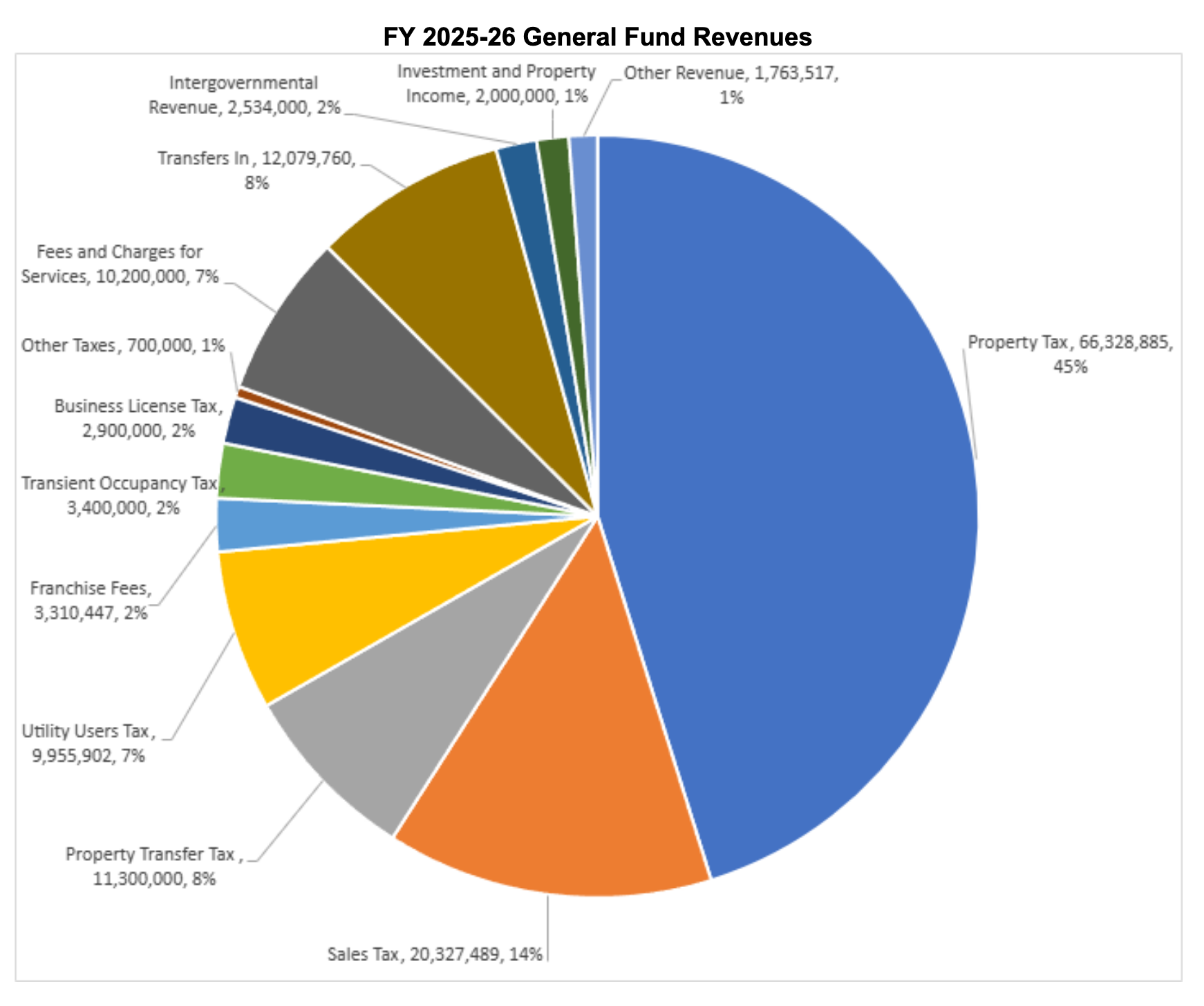
By chance, that's almost exactly the same size as the currently projected residual fund balance at the end of the fiscal year of $10.8 million. In other words, if the City of Alameda did not have a property transfer tax, then the city would currently be projecting to tap into designated reserve funds — and staff would be leading the City Council through a much tougher budget discussion this evening.
While Howard Jarvis is no longer with us, the association named after him is currently trying to make exactly that sort of dire budgetary situation happen.
Their Local Taxpayer Protection Act to Save Proposition 13 would cap all property transfer taxes at $1.10 per $1,000. Recall that that is the amount that the County of Alameda collects. So if passed, the measure would (by my read) completely eliminate the City of Alameda's property transfer tax.
A timeline of how Alameda built this stable revenue stream
City of Alameda's property-transfer tax is well established:
- City Council voted to establish a property transfer tax of $2.20 per $500 in May 1978.
- City Council voted to raise the tax to $5.40 per $1,000 in 1993.
- Alameda residents voted to raise the tax to $12.00 in 2008.
To summarize: This is a long-standing and well-established source of local revenues for City of Alameda.
But the dates in that timeline also reveal how Howard Jarvis n' Friends have repeatedly been opposed to this source of locally controlled revenues for public services at each step:
- Proposition 13 appeared on ballots in June of 1978, immediately after the City of Alameda's initial property transfer tax was passed by City Council. The text of Alameda City Council's ordinance directly spells out the relationship:
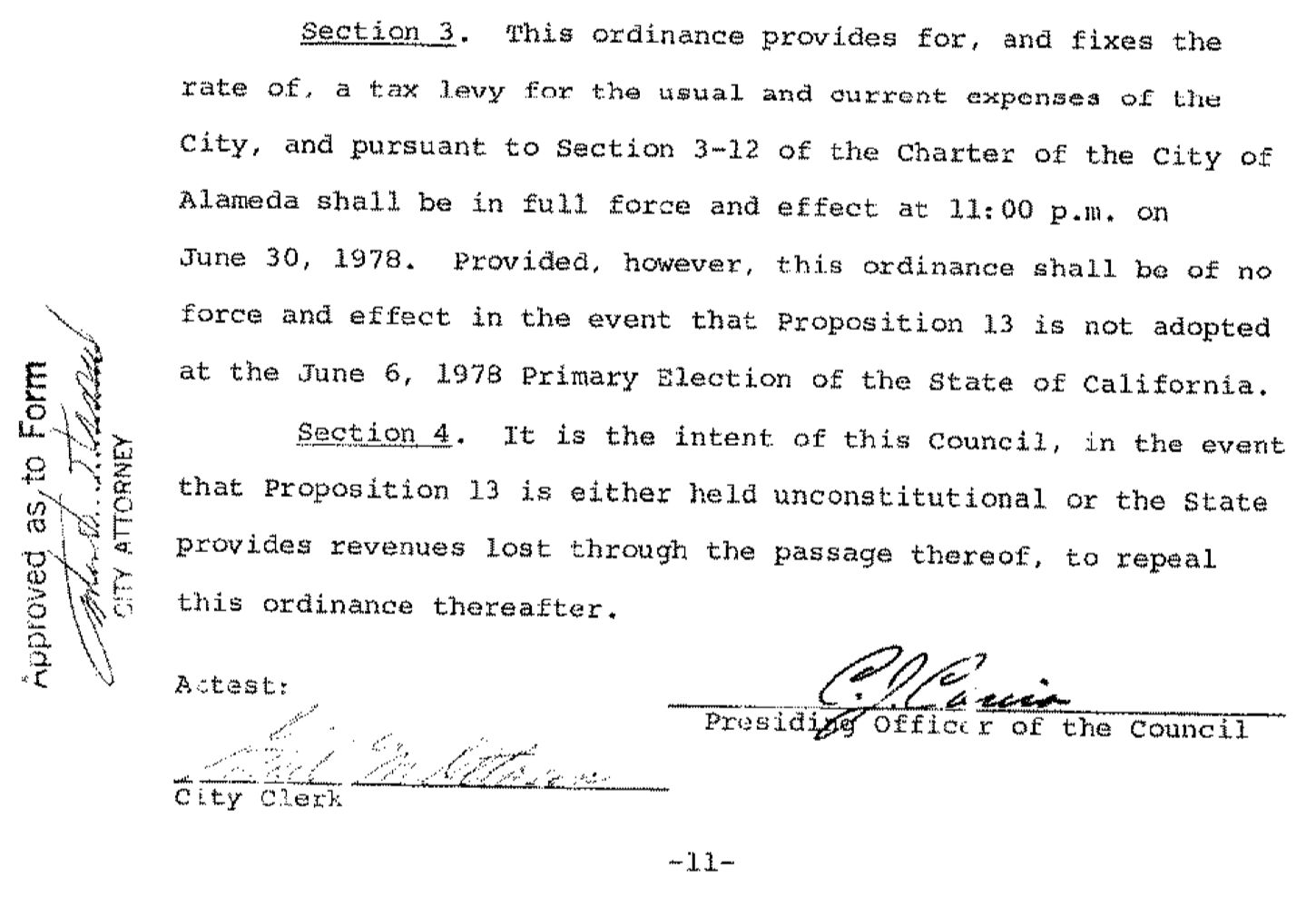
- The city's property transfer tax was passed as preparation, in case voters passed Prop. 13 — and severely constrained the city's property tax revenues.
- While the City Council, as elected representatives, could set the property transfer tax in 1978 and in 1993, they had to ask the voters to do so in 2008. That's because of two additional rounds of Jarvis-sponsored propositions: Proposition 62 in 1986 (Jarvis's last rodeo before his death) and Proposition 218 in 1996 (sponsored by a Jarvis-less HJTA). It apparently took two attempts, because Prop. 62 didn't apply to charter cities such as Alameda. Alameda followed the new full HJTA-approved rules and a majority of voters approved the increase in the property transfer tax in 2008.
Protecting local control, services, and infrastructure at the ballot box
But HJTA is never fully satisfied when California governmental agencies are able to collect taxes to provide public services. So they want to change the rules yet again — this time by eliminating Alameda's long-standing, multi-layered property transfer tax. This proposition may be advertised as a way to reduce your tax burden, but like most HJTA-sponsored propositions, the intended winners are specific business interests. The entities that stand the most to gain by removing these property transfer taxes are buyers, sellers, and holders of commercial real-estate. (Recall the point earlier about how much of City of Alameda's property transfer tax revenues come from commercial property transfers; residential, especially single-family houses are still important contributors but not the primary source of the revenues.)
This is an important year to support Alameda and Bay Area public services and to improve aging infrastructure at the ballot box. With this miserly ballot measure also coming to ballots, it will simultaneously be a critical year to protect what we already all depend upon.