On the agenda for Tuesday evening's City Council meeting is a referral from Councilmember Tony Daysog that will likely lead to a lively public conversation.
If I may, in advance, carve that conversation into two distinct topics:
- Recent repaving of some of Bay Farm's streets involves striping that some residents strongly disagree with (thus Councilmember Daysog submitting this referral).
- The overall process of publicizing the city's Pavement Management Program, collecting an appropriate amount of public input, and effectively delivering results each and every year.
2025 Pavement Rehabilitation, Phase 43 Project
This post isn't about the first topic. A year ago, the city Transportation Commission held a public hearing. Here's the executive summary of that agenda item:
Staff will present the 2025 Pavement Rehabilitation, Phase 43 Project. The presentation will generally show the streets selected for maintenance and rehabilitation and highlight the planned striping and configuration modifications for Aughinbaugh Way, Mecartney Road, and Maitland Drive. Staff seeks Transportation Commission feedback on the proposed striping and configuration changes.
Like all TC meetings, the agenda was publicized through multiple channels. A cross-section of members of the public came in person and online. We all listened to the presentation. Members of the public — including Bay Farm residents and parents from Bay Farm public schools — gave public comments. TC members, myself included, asked clarifying questions and also gave our input. This blog's policy is to not characterize the comments of my fellow TC members. (I also try not to rehash my own comments too frequently... not for legal reasons but just to not overstay my welcome in readers' inboxes :) See Legistar for the staff report, written public comment, the staff presentation, and a full video of the entire meeting.
Councilmembers and members of the public may use Tuesday evening’s referral as an opportunity to discuss the repaving project — or, more frankly, to attempt to revisit project-level decisions made conclusively by Public Works staff exercising their professional judgment and following city-wide plans and policies. As for me, I already used last January's scheduled public opportunity to say my piece, and even though my understanding is that the final plan does not reflect some of the targeted feedback that I provided, I will not use this as an opportunity to rehash any of my comments.
What's a reasonable amount of public involvement in street repavings?
This blog post is really about the second issue: the process of public involvement.
Alameda's Pavement Management Program happens annually. As "phase 43" implies, this process has been happening for a while. Each year, city staff move across the city, picking some roads to repave and reseal in a 1/3 slice of the city:
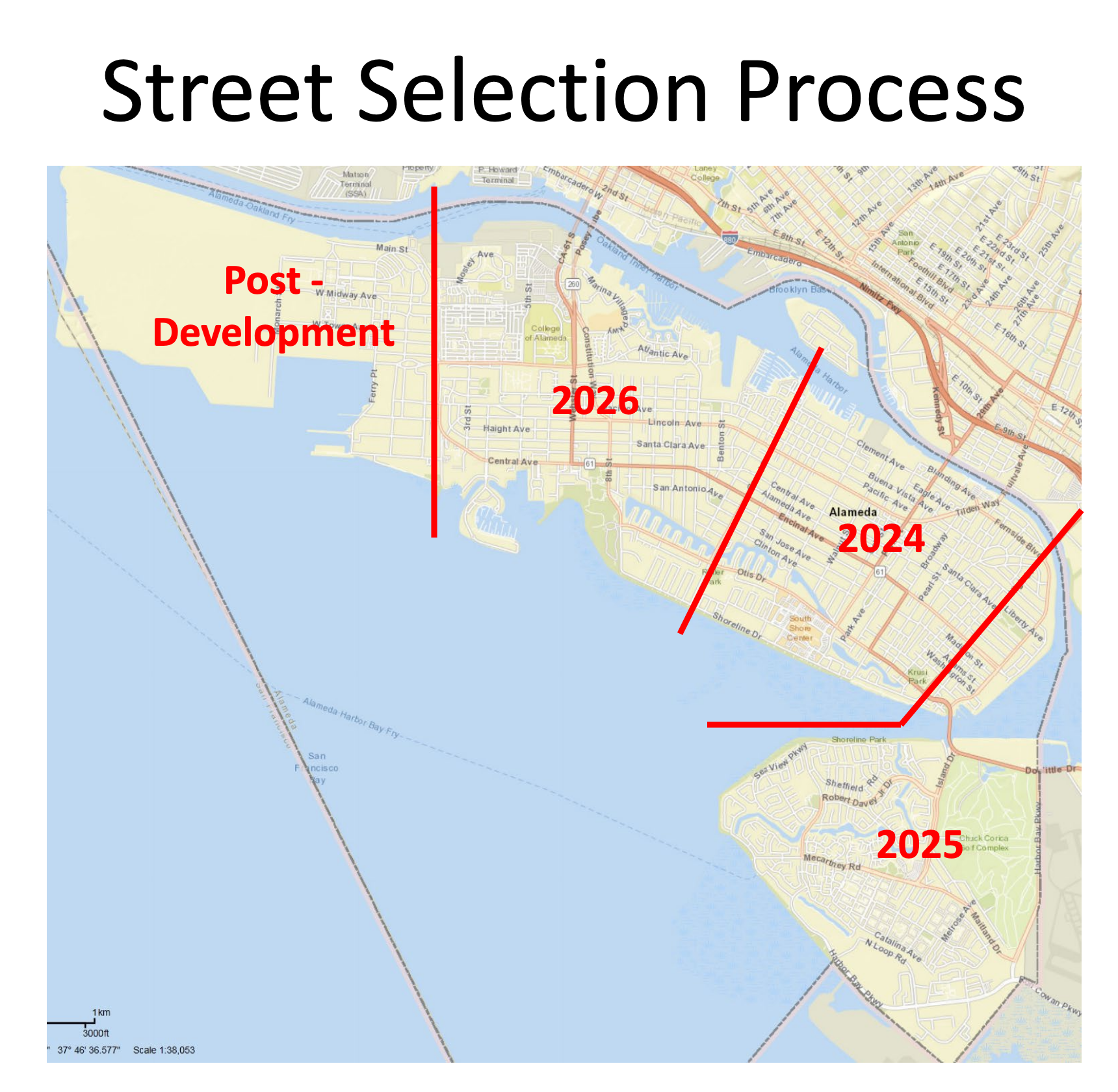
(Alameda Point is a world unto itself. After its streets are fully rebuilt from the ground up during redevelopment projects, those streets will then be maintained in the future as part of the annual Pavement Management Program.)
When Public Works staff begin the process each year, they consider a range of physical and budgetary factors.
While unfortunately Alameda does not currently have sufficient funding to bring all streets in the city up to a satisfactory pavement quality, Public Works staff are systematic in how they use available funds to target the "right treatment" for the "right street" at the "right time." They're spreading current funds as far as they can go, and prioritizing them for the types of pavement maintenance that will be most cost effective in both the near and long terms.
Note to self: Clip that presentation and post to YouTube since it's a useful baseline of information for anyone wondering why some streets are repaved while others aren't...
Before 2025, public input did not factor directly into each year's Pavement Management Program iteration. Rather, city staff aligned each year's engineering specifics and budgetary constraints with city-wide plans, including the General Plan's Mobility Element, the Transportation Choices Plan (2018), City Council's resolution adopting NACTO guides for the design of all transportation projects (2020), the Vision Zero Action Plan (2021), and the Active Transportation Plan (2022). The goals, details, and maps of these plans each went through many rounds of public discussion and debate before being adopted by City Council votes. It's by factoring those plans and policies into the annual paving projects that city staff have previously involved the public in the Pavement Management Program.
That January 2025 Transportation Commission meeting represented a meaningful change in process — it was the first time that city staff recalled publicly presenting a draft of a Pavement Management Program project. So in addition to informing the project through the adopted city-wide plans, staff also accepted targeted questions and feedback for their consideration within the adopted policies and their professional and project constraints.
Pluses of more public involvement
Here's one small but substantive aspect that changed due to the resulting public questions and feedback:
- For those paved trails along some streets in Bay Farm where tree roots have cracked and lifted the pavements so that all cyclists feel is BUMP! BUMP! BUMP!, city staff had planned on repaving many of those paths while also repaving the adjoining roadway. When they already have a contracted pavement firm on site, it's a very marginal increase to the budget to repave some adjoining paths.
- However, city staff hadn't thought to fully repave the section of path that cyclists use when coming from the Bay Farm bike/ped bridge, past Veterans Court, and south toward Bay Farm's shopping center.
- At least one public comment identified this oversight, and staff used it as an opportunity to slightly expand the project at very marginal cost.
- The roadway for Veterans Court, which is effectively underwater at king tide and storm events, is such a large civil-engineering endeavor that members of Congress and the state legislature come there to give speeches — but those important open challenges don't need to stop comparatively cheap upkeep in the meantime to help pedestrians and cyclists traverse that general area.
- These are small but concrete improvements that may happen to paving plans when shared in draft form with the wider public. (Well, they aren't concrete changes —they're asphalt changes :)
Challenges of more public involvement
Even as opportunities for direct public involvement have potentially beneficial outcomes, these process additions do add complexities and risks. Here's the biggest one:
- City staff need to work this public presentation into the overall Pavement Management Program timeline.
- City staff try to schedule as much as possible of each year's paving and striping for the summer season, when auto traffic is relatively lighter and there isn't rain to interrupt paving and painting.
- But project plans need to be fully finalized before that year's paving/striping goes out to bid.
- And looking forward, the process needs to happen all over again for another third of the city next year.
So there's some room for opening this previously fully internal process to targeted public involvement, but those opportunities need to be carefully scheduled and time-bound. To account for these new additions to the Pavement Management Program's Gantt chart, my understanding is that Public Works staff may now be needing to plan on a two-year time horizon, with one third of the city in initial planning and one third of the city closer to execution.
I mention this not to blame but rather to highlight a risk: The more tightly timed the Gantt charts are for ongoing programs like the Pavement Management Program, the less flexibility staff and city leadership have to adjust the "critical path" to accommodate changes in resources and staffing and everything else that happens unexpectedly.
A "Goldilocks" amount of public involvement
How can the City of Alameda make a good-faith effort to involve the broader public in some infrastructure projects like the annual Pavement Management Program, while still effectively and efficiently delivering real results within the constraints of budgets and timelines?
That's the type of question this blog has been asking repeatedly:
- "Alameda and the three bears... of public engagement" was my first attempt (in 2023) to frame this question.
- "Alameda and the three bears... of public engagement: Part II" (in 2024)
- "Welcoming Alameda's public housing east of Broadway" was (in 2025) one of this blog's more recent references to that question.
Every time I bring this up it's as if I've touched the most delicate of nerves. I'm now used to some of the reactions that this framing can elicit, so I wasn't that surprised to read the first comment on that 2025 blog post:
Your opinion on the "Goldilocks" amount of public comment reveals you to be an elitist. What you want is the "right" comments from the "right" people. People with a different dream for their neighborhood than yours are "wrong" and shouldn't even be wasting Good People's time by showing up and exercising their rights.
The reality of Alameda is that we depend upon city leaders to find a healthy balance in these very practical questions.
Our staff leaders and our elected leaders may not necessarily use the same language and approach as I use in these blog posts for valid reasons:
- Many politicians prefer to talk positively, even about zero-sum tradeoffs. It makes sense that elected officials aim to make sure their constituents feel heard and represented.
- Staff need to be neutral in how they engage public participants (even if not all of us members of the public are necessarily always acting in "good faith" with our comments and questions).
In whatever way and whatever language our staff and elected leaders approach these process questions, active choices to calibrate public-involvement processes do need to be made. (These choices aren't just about the Pavement Management Program, they're choices to be made within the unique context of every transportation project, every substantive policy change, every public service represented as a row in the City of Alameda's Master Fee Schedule — each topic with its own constraints and interested parties.)
I hope residents, local business owners, and other stakeholders in Alameda can appreciate how, even if we can't always agree on all the specifics every time, we do all generally benefit when the City of Alameda hits a sweet spot with public-engagement processes — and effectively and efficiently delivers results.