Long live Otis Elementary
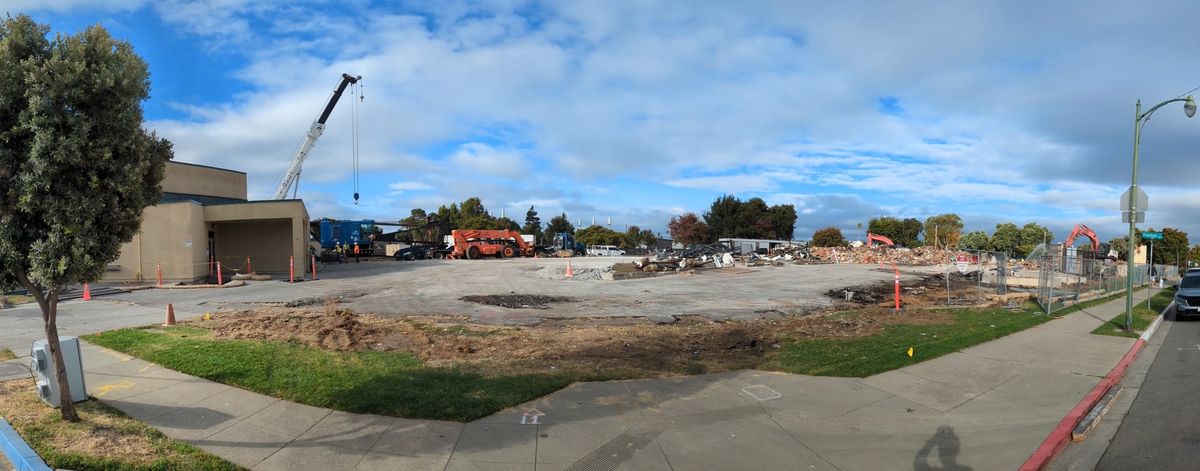
After bike bus'ing my kids to school the other morning, I cycled back to the East End to check out what my 5th grader now refers to as "the Krusi Park school."
In her view, the buildings and the parcel that are currently under construction next to Krusi Park are no longer "Otis Elementary." Rather, she considers "Otis Elementary" to be wherever her classmates and her teachers are — currently in portable buildings on blacktop midway across Alameda Island.
That includes Ms. Gilbert's parakeets, who are now settled at the campus-away-from-campus. That's fortunate, since Ms. Gilbert's previous classroom — the classroom where my daughter was a 1st grader (along with "Marshallow" and "Blueberry," that year's parakeets) — was the exact spot on which a large piece of construction equipment was operating as I arrived:
As I stood on the sidewalk observing, a passing car stopped and a dad and a very young kid emerged. We all watched the (de)construction for ~10 minutes, all clearly fascinated by the process.
Farewell to the old Otis — and portions of the soil underneath it
A couple months ago, I began skimming a report filed with the California Department of Toxic Substances Control regarding the Otis Elementary construction. My thought at the beginning of the 480 pages was "is this going to delay construction? will my younger kid be at the temp. campus longer?" — but by midway through the document my thoughts changed to "have my kids ever licked that downspout or eaten that dirt?!"
Let's pause for some context: The main Otis Elementary building was built atop where "land" originally gave way to "bay." Also cutting across the site was a tidal slough, which has since been artificially filled:


Left: USGS topographic map from 1897 with the future Otis Elementary campus in red. Right: Aerial imagery from 1939 with the future Otis Elementary campus in red.
917.9465 MINOR in the main library.My non-expert read of the DTSC filing is that there are pockets of lead in select locations underground, which likely arrived both with the artificial fill dumped into the tidal slough and with years of rain dripping down lead paint on the original school buildings. The fill also likely included arsenic and hexavalent chromium.
ARSENIC and HEXAVALENT CHROMIUM?! Yeah, those are the words the report uses. But before you also freak out and wonder where your kids licked the dirt: This low but non-zero level of arsenic is typical for Bay Area soil generally. My non-expert read is that these materials are in such small quantities and have been capped by pavement or dirt, so they have not been safety concerns for students or staff for multiple decades. The specifics of this report mainly concern proactively protecting the construction workers on the site as they remediate very specific locations.
The reality of building in the inner Bay Area is that nowhere is a pristine "greenfield" site. In fact, the nature of these being sites where people have already built — and erred with contamination in the past — is a good feature. It means that we're putting our collective money toward reusing our existing places in the inner Bay Area, rather than sprawling ever outward into land that is ideally kept open for agriculture, recreation, and nature.
One complicating side effect is this means that opponents to redevelopment projects can often find AN UNDERGROUND TOXIC HAZARD. (See, for instance, neighbors' latest attempt to halt the Marina Safeway redevelopment in San Francisco). At the same time, redevelopment is often the means to actually pay to remediate existing conditions, gather than to leave these problems to future generations.
As camp leaders say as you're packing up, please leave the campsite cleaner than you found it — and that seems like a similarly reasonable approach to take as public and private entities rebuild buildings and campuses throughout Alameda and the Bay Area.
A riff on people vs. places
Back to how "Otis Elementary" is wherever the students, teachers, and staff (as well as the parakeets and I believe one chinchilla) are presently located.
At points in my own life, I've been enamored with the design of cities and neighborhoods and campuses and buildings — the physical structure enabling urban societies and economic agglomerations — but perhaps in the process forgetting about people.
Here's one story: For one college graduation, I auditioned a speech about how much our graduating class benefited from the walkable campus environment. I encouraged everyone to seek out places of density as they continued their adult lives. I probably gave a paean to big cities, prewar street car suburbs, transit networks, maybe a shoutout to the New Urbanism trend already underway? I vaguely recall one similarly pedantic friend appreciating it while I workshopped it with him. But perhaps it's for the best if that draft (if I'm even recalling it correctly) is lost to the winds of time, since the selected speaker was probably much more inspiring — she spoke instead to relationships formed by students and how to carry those forward. A call for friendship, rather than a lecture on the built environments of postwar America. (Speaking of America, that was also the year in which every single commencement speech began with a somber pronouncement of Soon after this class arrived in September 2001 [dramatic pause], the whole world changed...) Anyway, that's about all I recall from that graduation.
That my 10 year old is currently thinking of people before physical places is perhaps a contrast I can also learn from.
Places and people
That said, we need people and we need places.
Students and teachers need classrooms — and students and teachers benefit when those classrooms are sun-lit, free of roaches (even if my kids' stories of roaches at the old Otis have mainly been told to laughter), and have air conditioning available for the unfortunate new reality of our wildfire seasons.
Otis Elementary's students and staff will benefit from a fresh new campus — both above ground and below ground — when they return in ~2 years. (By that time, my oldest will be at Lincoln Middle School, which is itself slated to have coming renovations — eek! — although without a planned campus move — phew!)
Thank you to the voters and taxpayers of Alameda for revitalizing Alameda Unified's physical facilities — in support of the personal connections and relationships underway in those classrooms each day.