Thanks to aging broken pavement on Park Street and San Jose Avenue, and thanks to the speed and quantity of cars and trucks driving along both roadways, Alameda's City Council has enabled a downtown beer garden and eatery to continue to host live music on its outdoor patio.
No one phrased it quite like that (outdoor music only legally due to the ambient noise of "motordom") but that's the way a legal needle was effectively threaded.
Tuesday evening's City Council meeting (where the beer garden's use-permit and a neighbor's threat of a "CEQA" lawsuit were on the agenda) was packed. Unlike epic Alameda City Council meetings of yore, neither side wore color-coded t-shirts, although many supporters of the venue did wear pins. When I showed up mid-way, I got one of the last seats in Council Chambers (although I passed on taking a pin). A news crew set up a camera to film.
Aside from the made-for-local-TV drama of a civic conflict, the details themselves were tedious:
- The appeal of the Planning Board's permit decision triggered this de novo hearing by the City Council (not an unusual occurrence).
- But the lawyer filing the appeal on behalf of a neighbor made grand references to "CEQA" aiming to effectively place the city and Park Station in a circular trap: CEQA specifically notes that a project's potential noise effects must be evaluated against a city's noise ordinance. But Alameda's noise ordinance is woefully outdated and doesn't define specifics for Alameda's mixed-use business districts. So how can a CEQA-related judgment be rendered by the Planning Board or the City Council if its basis in the municipal code isn't sound? If the city seeks to revise its municipal code (as staff propose to do in the coming fiscal year) then that will need its own environmental determination... exposing the city to further "CEQA" scrutiny. Gotcha!
In the case of Park Station, time means money in that if the venue isn't allowed to hold outdoor music during a year-plus of revision and CEQA analysis for changes to the city's General Plan and Alameda Municipal Code's noise ordinance, then Park Station is presumably losing revenue from the draw of outdoor events.
In the case of public projects, time means money in terms of raising construction prices. While not directly CEQA-related, Alameda's aquatic center was announced at this same City Council meeting as requiring an infusion of $5 million from the city's General Fund to meet higher-than-expected construction bids. The longer a project is delayed, due to internal or external reasons, the higher it may cost to complete.
Speaking of eating time, this City Council meeting went until 12:30 a.m.
- While I'm quite sympathetic to the concerns of the immediate residential neighbors of the beer garden, I'm less sympathetic to the arguments made on their behalf by this CEQA lawyer. For instance, the appellant's lawyer wrote to City Council that "allowing amplified outdoor music is not a normal part of creating a vibrant downtown":
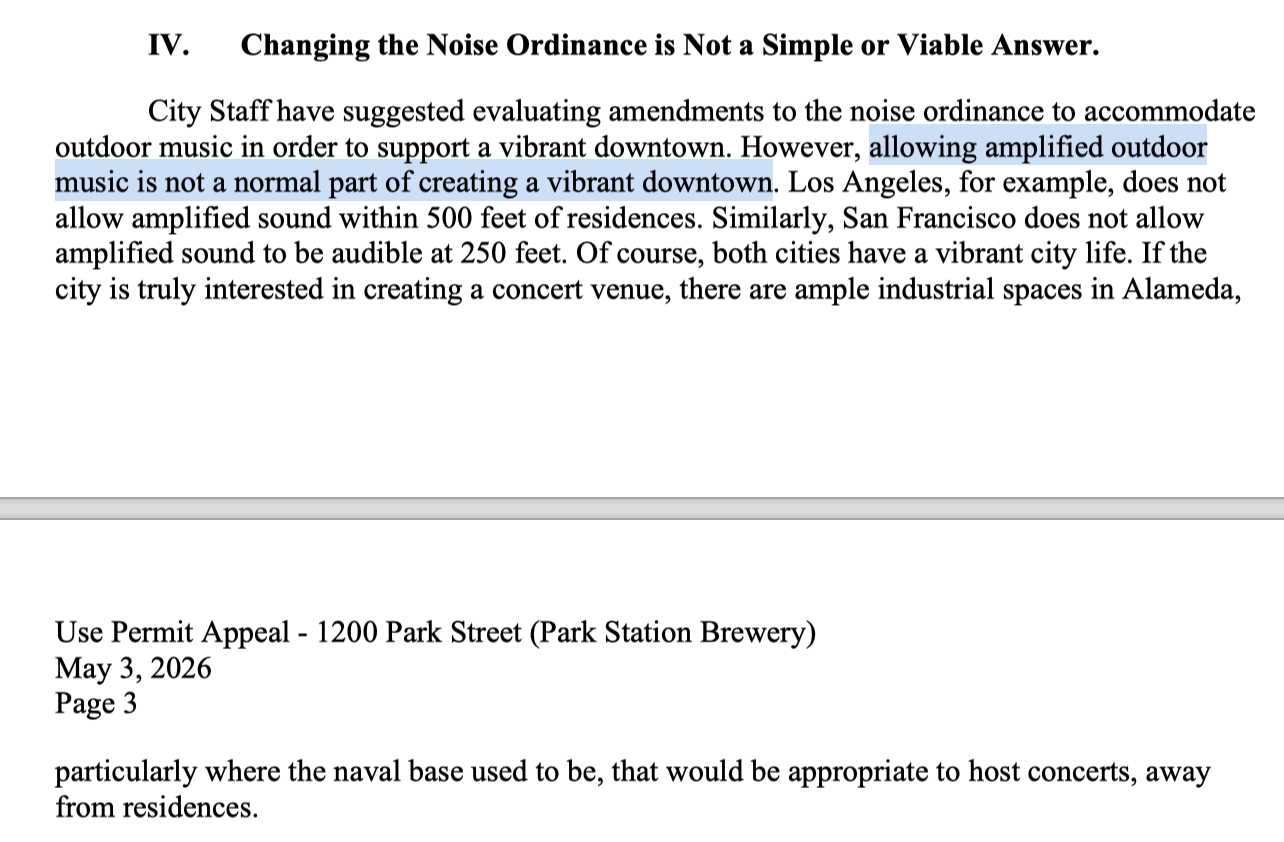
- While I don't think that having professional training in urban planning is a prereq for commenting on urban planning topics (and some professionals with the most planning credentials demonstrate the least understanding of the dynamics of urban life), let's not listen to environmental law lawyers when it comes to what is a "normal part of creating a vibrant downtown" in this case.
- Just the small extract from the lawyer's correspondence also raises major red flags with its mention of Alameda Point as "ample industrial spaces [...] away from residences." The lawyer is so narrowly focused on her client that neither seem aware that two weeks prior at the last City Council meeting, the two litigants who sued to halt the Alameda Food Bank project submitted letters hinting of "CEQA" action against the proposed Radium concert venue project at Alameda Point.
- Navigating through this thicket of details, what staff proposed to City Council is a surrender that is also a quite clever solution. Instead of basing a use-permit upon a fixed decibel amount (which is currently indefensible) or upon the residential limit (which is effectively impossible), Park Station will simply not be allowed to exceed ambient noise levels. Thanks to all the cars and trucks driving over the pot-holes of San Jose Ave and lower Park Street, there's a lot of ambient noise. There's also jet engines from OAK and the BART "banshee" and the semi-trucks of 880 (which are still not allowed on 580). All of this background adds up to a baseline that Park Station can now amplify their live concerts against. (Note that the permit also separately caps the number of concerts per month and the hours of performance; firm limits had been established by the Planning Board and were re-issued by City Council.)
- As a floating limit, this new limit shifts the terrain of the debate: Now the question for Park Station and neighbors (and potentially their lawyers) will be the exact definition and value of ambient noise.
- Park Station recently installed measurement equipment that will have live readings available to both the business and the appellant. This may be a meaningful shift of their relationship from pure "he said/she said"-style acrimony to a more productive "trust but verify" basis.
- This specific permit will return, along with those measurements, to the Planning Board in four months. All stakeholders, from neighbors to patrons, will have another chance to share their thoughts on what's working and what isn't.
City of Alameda elected officials and staff members have successfully resolved this appeal in a manner that doesn't immediately threaten city-wide policies or other projects. Still, the City must follow through on a systematic update to noise provisions in the General Plan and Municipal Code — otherwise when San Jose Ave is paved and upgraded to a Neighborhood Greenway, the sounds from all those cars and trucks plopping into the potholes and accelerating over the rough pavement may no longer enable this compromise.