"BUILD. MORE. AFFORDABLE. HOUSING," I happily shouted — but state senator Scott Wiener scowled back at me. I continued: "YES ON ESS BEE EIGHT TWENTY SEVEN." and the hardest working legislator in California, sitting atop a classic car, slowly moving down Market Street, relaxed his frown and gave a thumbs up.
That parade was ~7 years ago, just as Wiener had introduced his first attempt to legalize denser housing development around high-frequency transit stations — and just as I was learning the lingo of housing activism. You see, "affordable housing" is often used in advocacy circles and newspaper op-eds as a phrase to oppose new housing and new legislation (and so Wiener probably figured I was opposing the bill). But I simply was pleased about his attempt to build more, in logical places... which would presumably result in housing being more affordable overall.
Whatever phrases are used to describe building more housing near transit, others disagreed strongly, and Senate Bill 827 was defeated in a senate committee meeting. Wiener's next attempt, SB 50, was defeated once in a senate committee, then made it out of all the committees in yet another attempt, and was defeated again on the senate floor.
A "Transit-oriented Development and Upzoning" bill finally passes in 2025
With much tenacity and many compromises, 2025's attempt — SB 79 — passed through all the gauntlets in the state senate, as well as the state assembly. But it was an open question whether Governor Newsom would sign the bill, silently allow it to be enacted, or veto the entire thing. In the fall, supporters were still attempting to divine his intentions from a Twitch stream in which @ConnorEatsPants took a break from playing Fortnite with the governor to ask him if he was going to sign SB 79. (No, I don't know who @ConnorEatsPants is, nor do I know what a Fortnite is.)
Newsom did it. He signed SB 79 — and a clock started. On July 1, 2026, state law will take precedence over local zoning codes around key transit stops. Property owners will be given the option to build higher and denser, as long as they follow specific guidelines. For instance:
- SB 79 cannot be used to demolish rent-controlled apartment complexes.
- In Very High Fire Hazard Severity Zones, higher building standards apply and cities can retain the option to waive the upzoning.
- A certain amount of subsidized affordable housing will be required through inclusionary zoning (the key word being subsidized — something other than hopes and prayers makes those housing units actually affordable to below-market rate households).
- SB 79 only applies in "urban transit counties." What's an urban transit county?It's easier to say what an urban transit county is not. It's not Marin County, since the recent president pro tempore of the state senate is from Marin. It's also not Contra Costa County, since according to the Mercury News:
The Contra Costa County Board of Supervisors and city councilmembers in Lafayette and Orinda — both home to BART stations that would have been subject to up-zoning to allow higher density — lobbied their state lawmakers to get the amendment passed. They argued that SB 79 would increase density along fire evacuation zones in the county and put existing residents at risk.
- Didn't we just talk about how SB 79 gives local cities the option to decline the upzoning in Very High Fire Hazard Severity Zones? Yes. It's that same challenge as when some argue they just want "affordable housing" — and what they implicitly mean is that they want no new housing. SB 79 and its predecessors have had all these protections in place, but opponents continued to argue against it in bad faith. To get the bill over the line has required making deals to appease those with power — such as representatives from Marin and Contra Costa counties — in order to get something done for the other more critical urban counties of the state.
- Alameda County is — after the sausage of SB 79 was made — an "urban transit county."
Does it affect Alameda?
What about the City of Alameda? Will SB 79 apply here in Alameda on July 1, 2026?
Now, that's an even more challenging question to answer than What is a Fortnite?, or Why would anyone find it entertaining to watch Mr. @ConnorEatsPants play video games with the governor of California?
The short answer is to wait for MTC (as the Bay Area's metropolitan planning organization) to "create a map of transit-oriented development stops and zones within its region by tier, as designated under this chapter."
But this blog typically prefers the long answer. Let's try to figure out which, if any, transit stops within the City of Alameda qualify for SB 79 upzoning.
Thank you to the YIMBY posters on Bluesky, including Alameda's Zac Bowling, who have informed the following analysis. (I should also ask them what a Fortnite is.)
"Tier 2 transit-oriented development stop"
Let's start with SB 79's additions to Chapter 4.1.5 of the California Government Code.
Section 65912.156 creates two new definitions:
(n) “Tier 1 transit-oriented development stop” means a transit-oriented development stop within an urban transit county served by heavy rail transit or very high frequency commuter rail.
While we already know Alameda County is an urban transit county, there are no stops within the City of Alameda that are served by rail... currently. When the Link21 project brings Caltrain to the East Bay, then we'll hopefully have a qualifying rail station in Alameda.
In the meantime, the question is whether we have SB 79's Tier 2 of transit stop:
(o) “Tier 2 transit-oriented development stop” means a transit-oriented development stop within an urban transit county, excluding a Tier 1 transit-oriented development stop, served by light rail transit, by high-frequency commuter rail, or by bus service meeting the standards of paragraph (1) of subdivision (a) of Section 21060.2 of the Public Resources Code.
City of Alameda does have some high-quality AC Transit routes and frequently-served stops. Could these qualify?
"Bus rapid transit" (Part 1 of 2)
We'll have to go check the California Public Resources Code next:
PRC 21060.2.
(a) “Bus rapid transit” means a public mass transit service provided by a public agency or by a public-private partnership that includes all of the following features:
(1) Full-time dedicated bus lanes or operation in a separate right-of-way dedicated for public transportation with a frequency of service interval of 15 minutes or less during the morning and afternoon peak commute periods.
There happen to be two bus stops within Alameda city limits that meet the requirements of paragraph (1):
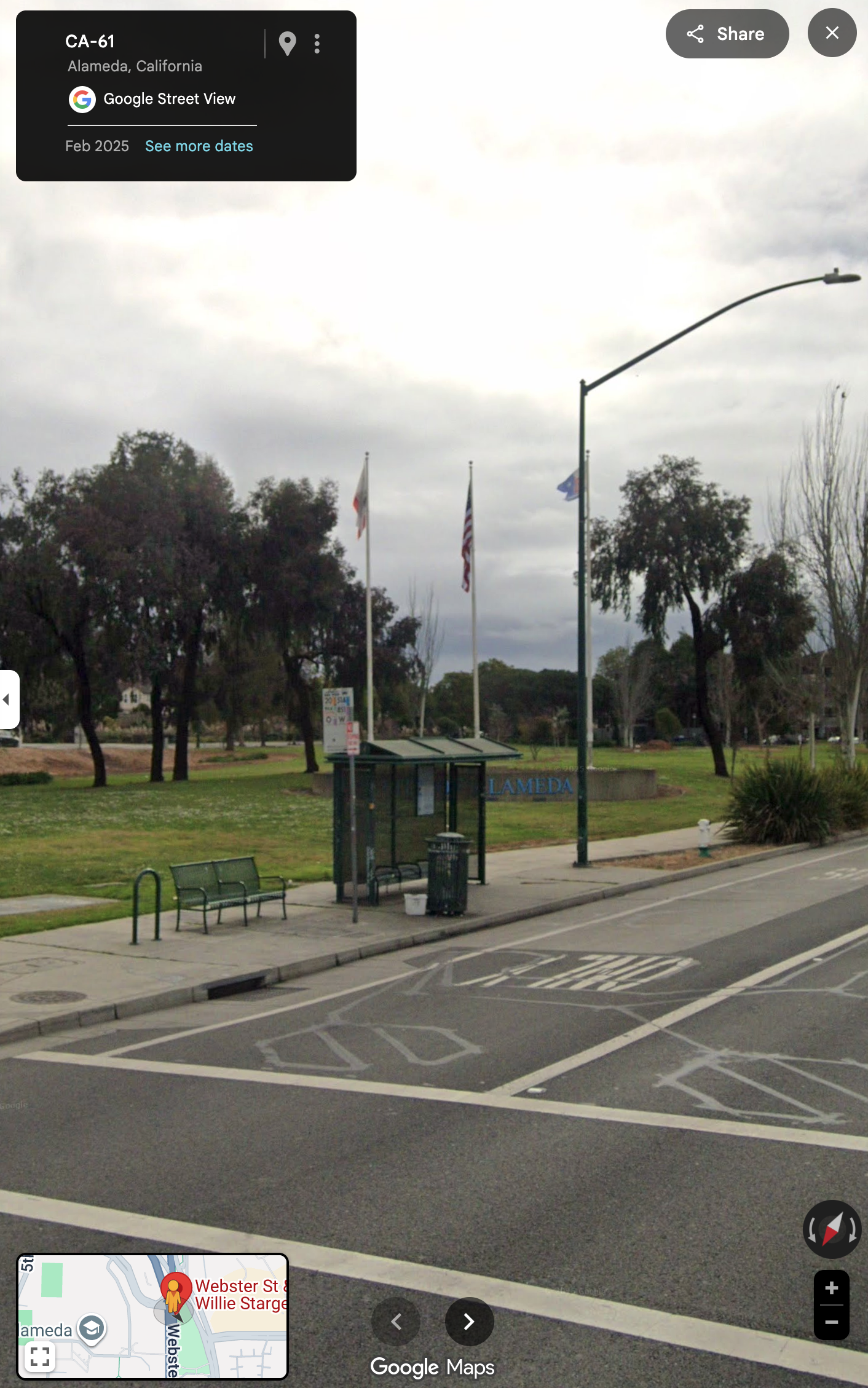
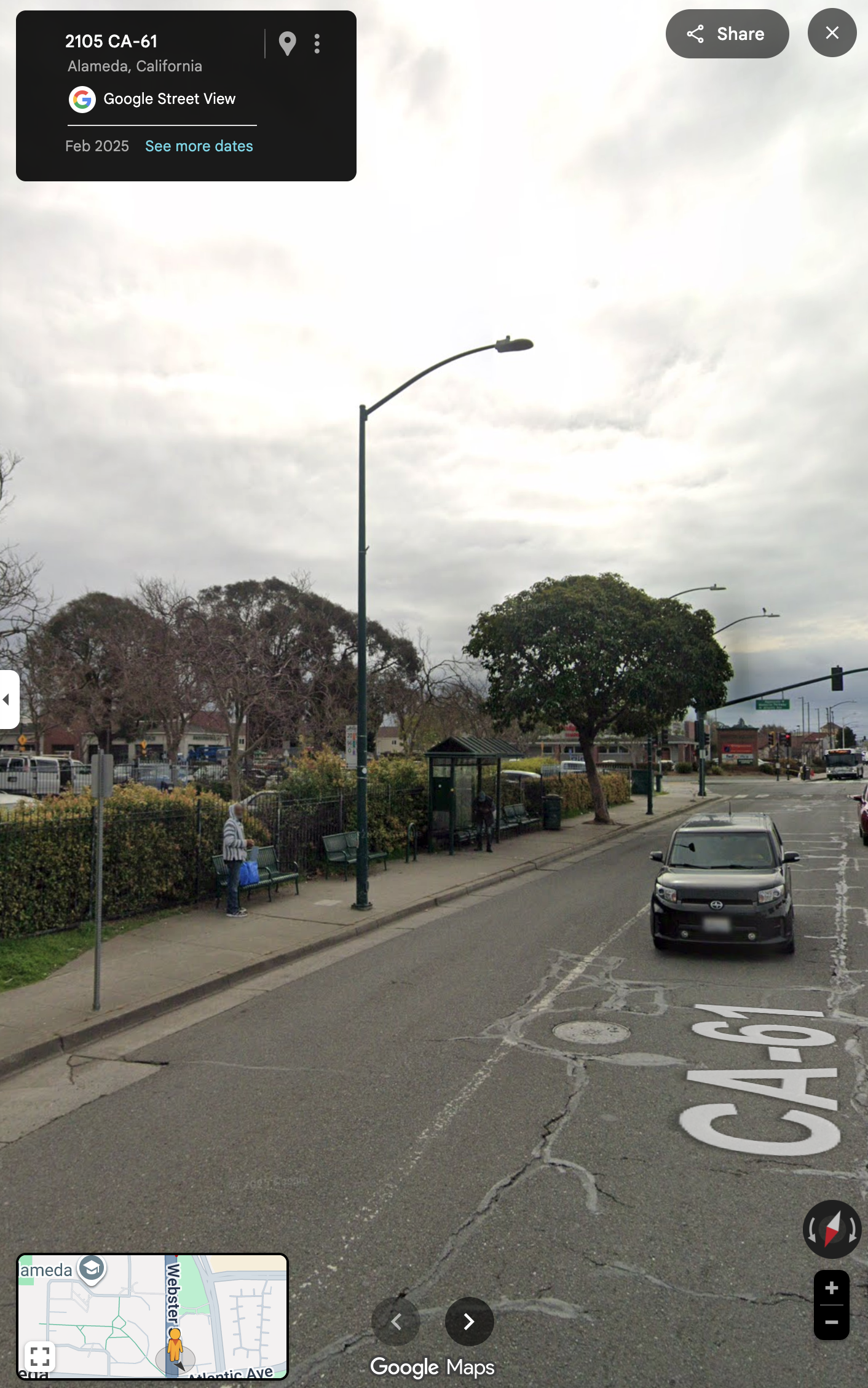
Right before Webster St enters the tube, there is a dedicated curbside bus-only lane that enables AC Transit buses to continue past cars in the main thru-lanes.
Multiple AC Transit lines stop at these two stops, including the Line 51A Broadway, which more than meets the 15-minute headway (frequency) required by PRC 21060.2(a)(1)
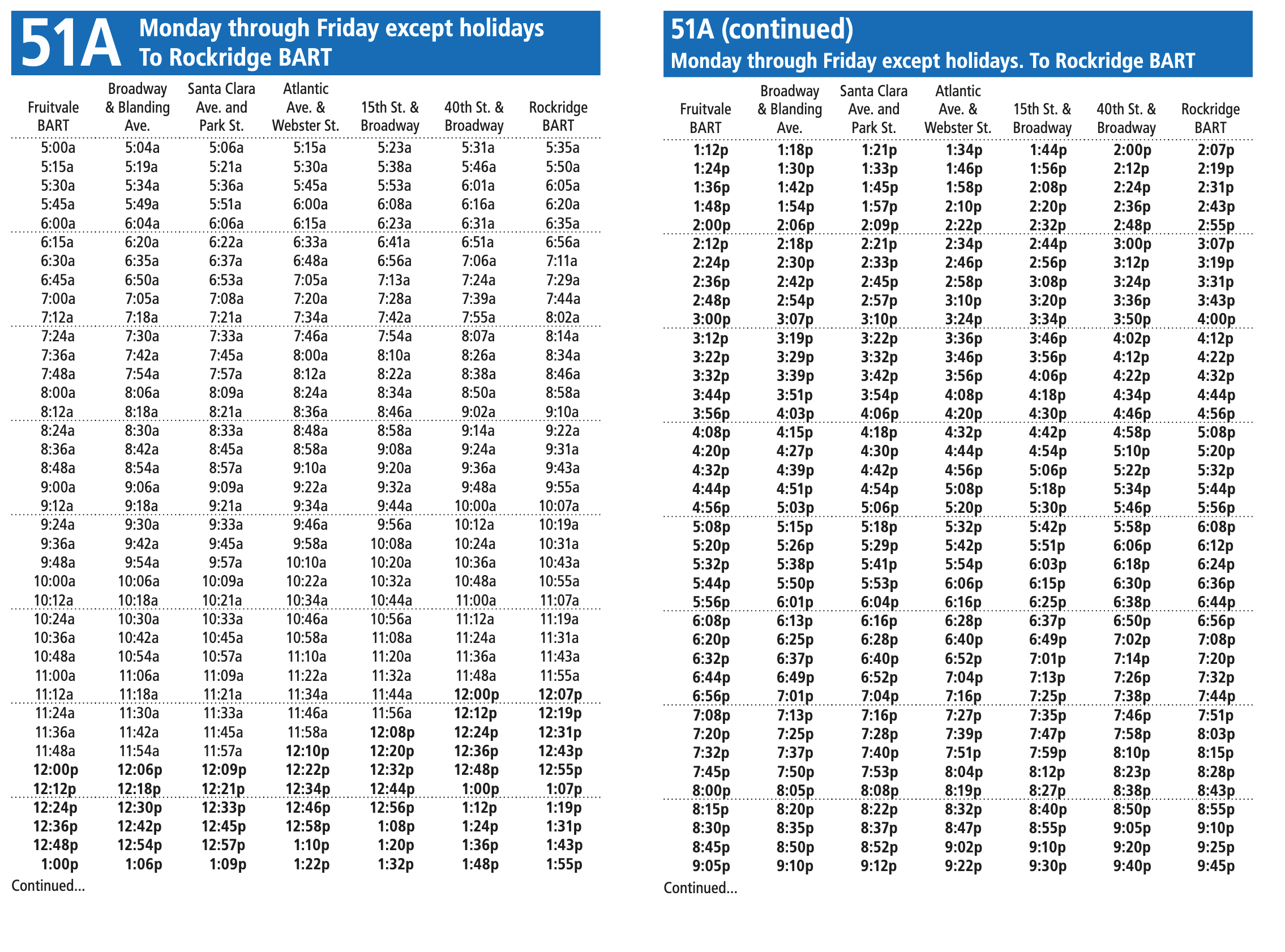
Aha! SB 79 will upzone a portion of Alameda.
"Transit-oriented development stop"
But not so fast. The next bullet in SB 79 further defined what a "transit-oriented development stop" (of either tier) means:
(p) “Transit-oriented development stop” means a major transit stop, as defined by Section 21064.3 of the Public Resources Code, and also including stops on a route for which a preferred alternative has been selected or which are identified in a regional transportation improvement program, that is served by heavy rail transit, very high frequency commuter rail, high frequency commuter rail, light rail transit, or bus service within an urban transit county meeting the standards of paragraph (1) of subdivision (a) of Section 21060.2 of the Public Resources Code.
"Major transit stop" and "Bus rapid transit station"
So back to the California Public Resources Code again:
PRC 21064.3.
“Major transit stop” means a site containing any of the following:
(a) An existing rail or bus rapid transit station.
(b) A ferry terminal served by either a bus or rail transit service.
(c) The intersection of two or more major bus routes with a frequency of service interval of 20 minutes or less during the morning and afternoon peak commute periods.
Our two stops in Alameda can meet the PRC's definition of major transit stop by being bus rapid transit stations. Remember how they already have dedicated right-of-way.
Let's double check to see what the PRC's definition of a bus rapid transit station is:
PRC 21060.2.
(b) “Bus rapid transit station” means a clearly defined bus station served by a bus rapid transit.
So to qualify for SB 79, our stops need to be served by bus rapid transit.
"Bus rapid transit" (Part 2 of 2)
What is bus rapid transit? For that we need to go back up to the top of these definitions. Previously we only focused on paragraph (1) since that was referenced directly by SB 79, but it turns out there are five paragraphs in total — and the Public Resources Code explicitly indicates that all of the following are required, not just the first item:
PRC 21060.2.
(a) “Bus rapid transit” means a public mass transit service provided by a public agency or by a public-private partnership that includes all of the following features:
(1) Full-time dedicated bus lanes or operation in a separate right-of-way dedicated for public transportation with a frequency of service interval of 15 minutes or less during the morning and afternoon peak commute periods.
(2) Transit signal priority.
(3) All-door boarding.
(4) Fare collection system that promotes efficiency.
(5) Defined stations.
So let's see if our two stops fit the criteria of paragraphs (2) - (5):
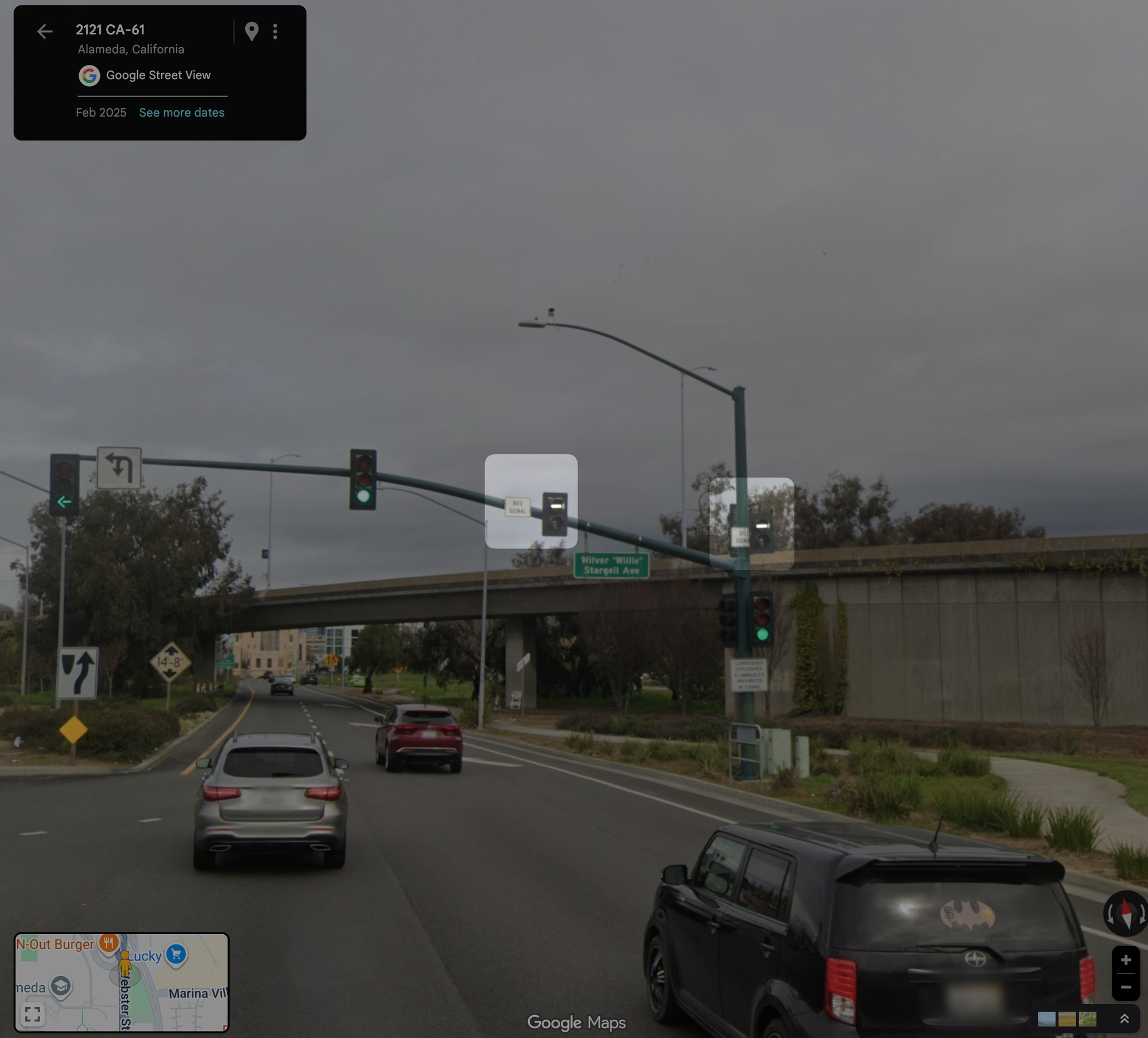
- ✅ Transit signal priority is implemented along Webster St. (and also an expanding amount of Park St) in Alameda — that enables arriving buses to request a green light as they approach a signalized intersection. Also note the bus-only signals that are specific for the dedicated bus lane:
- ⚠️ All-door boarding? Let's come back to that...
- ✅ A fare collection system that promotes efficiency? AC Transit has both traditional cash fareboxes as well as contactless Clipper Card readers. The latter would presumably meet the efficiency requirement, so checkmark.
- ✅ Defined stations? Yes, there are shelters and benches and lights.
- Enabling riders to enter a bus through all doors is efficient. It decreases the amount of time that a bus has to wait at stops for riders to file into a single front door. But all-door boarding does require a major policy change by transit agencies, called proof of payment. Rather than the operator of a bus confirming that every rider pays as they board, it's assumed that all riders have paid by some means or another — and if asked by a fare enforcement officer, then every rider must show their proof of how they paid. (It could have been by buying a paper ticket from the driver; it could have also been tagging on a Clipper Card reader at a rear door, or already having a monthly pass.) AC Transit has been piloting all-door boarding on the Line 51B (as well as the Line 6) but not on Line 51A. So, no, the Line 51A does not have all-door boarding currently.
What a strangely looping set of references.
Do these two stops qualify because they meet the explicitly cited paragraph (1) requirement in the Public Resources Code? Or do these two stops not qualify because they don't currently meet the "all of the following features" requirement that is only reached via at least three different hops through the Public Resources Code?
While the main action of the legislative sausage-making was focusing on how to clearly exclude the ferry terminals and SMART train stations in Marin County, these referential details for bus-rapid transit may have gotten much less attention.
While I'm neither a lawyer nor a real-estate developer, this looks like enough ambiguity that an interested party could have reasonable confidence in their potential to prevail in court to affirm their right to the more permissible interpretation.
ABAG's interpretation
The staff of the Association of Bay Area Governments also apparently settled on the more permissible reading. Their advisory document for Bay Area cities issued in November defined "bus rapid transit" against only PRC 21060.2(a)(1):
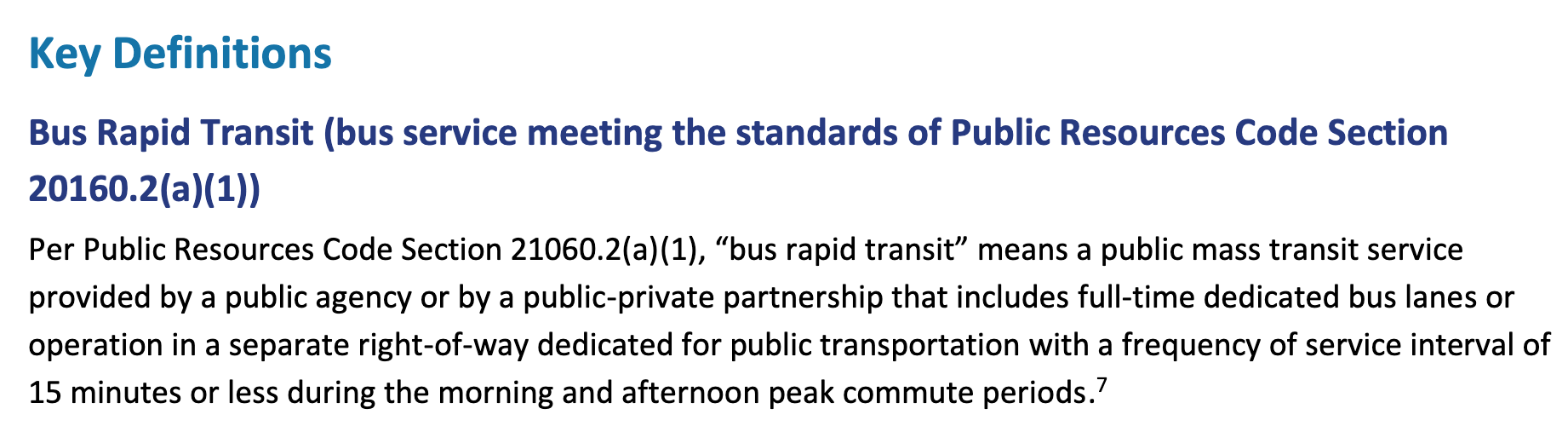
In a footnote, ABAG staff add the following clarification:
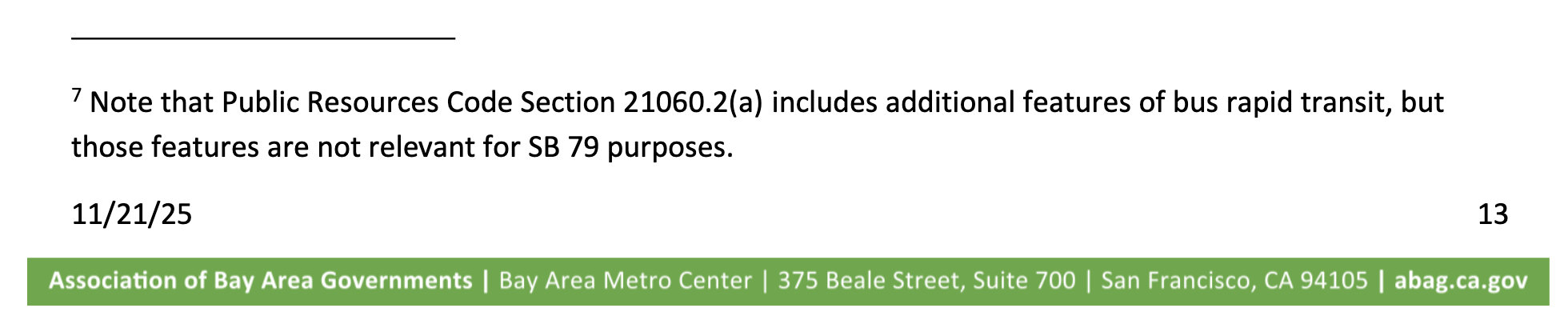
So that was just an academic exercise of evaluating whether those two AC Transit stops meet the "additional features" of:
(2) Transit signal priority.
(3) All-door boarding.
(4) Fare collection system that promotes efficiency.
(5) Defined stations.
All that matters according to ABAG is that those two AC Transit stops meet the requirements of:
(1) Full-time dedicated bus lanes or operation in a separate right-of-way dedicated for public transportation with a frequency of service interval of 15 minutes or less during the morning and afternoon peak commute periods.
So assuming we've got all these details right, those two bus stops will indeed appear as tier 2 transit-oriented development stops when ABAG/MTC staff prepare lists and maps of SB-79 eligible transit stops!
With that disclaimer out of the way, let's finally get to the question that will interest most people: What parcels in Alameda will be eligible for upzoning on July 1, 2026?
Let's make a map
Instead of showing you the messiness of all the geospatial analysis, I'm just going to pull a fully baked pie out of the oven, as if this is a cooking show:
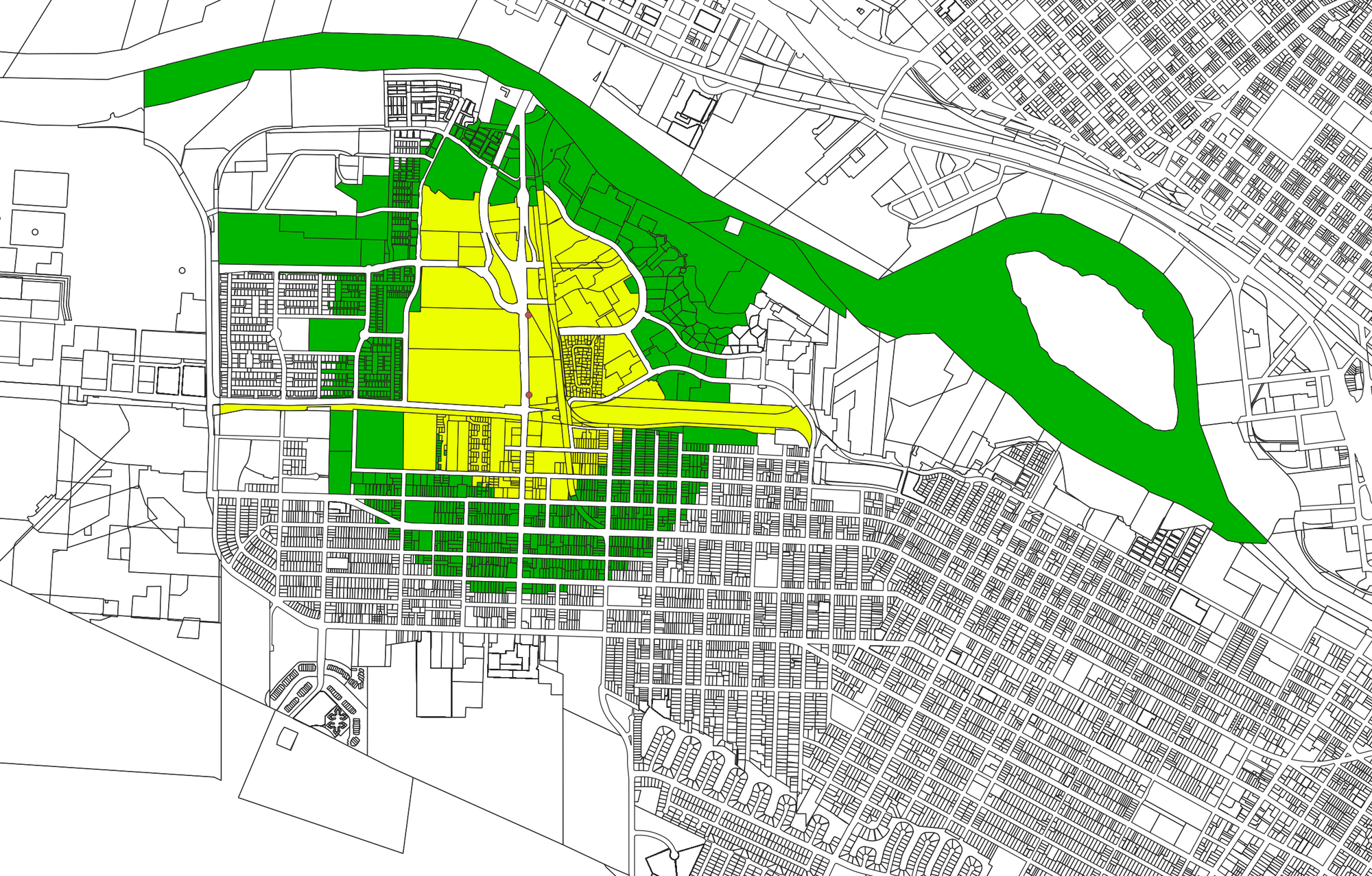
- Those two red points are our "bus rapid transit stations."
- The parcels with a lighter green background color are within a 1/4 mile buffer of at least one of the stops.
- The parcels with a darker green background color are within a 1/2 mile buffer of at least one of the stops.
- (Ignore the watery parcels in the estuary. I got tired of the complexity of operating QGIS and didn't know how to delete them.)
Potential effects in Alameda: Some minor, some major
Congratulations to all of the property owners with colored parcels! Your property values will likely go up a bit on July 1, 2026, when you may be entitled to build more kinds of housing on your land. Private property rights still apply — no one is forcing anyone to change anything. This is just an option for property owners — with additional requirements to protect existing tenants, to promote subsidized affordable housing, and (should buildings go over a certain height) to require skilled unionized labor.
Alameda has already modified zoning for certain areas around here, to promote mixed-use developments in shopping centers (as long as they retain a minimum amount of retail and grocery). But SB 79 may expand the potential for multifamily housing in additional areas:
- Along the lower portion of Webster Street, where the West Alameda Business Association argued that having any more shadows would be bad, so the city's current zoning code imposes highly constrained setbacks and floor-area ratios.
- The Union Pacific railroad still owns parcels of land on the southern side of Jean Sweeney Open Space Park that are colored light green on that map. Those parcels may soon be zoned for — should UP want to exercise their rights — building a new housing development with a healthy amount of subsidized affordable units.
SB 79 unlocks much more potential for housing, so starting on July 1, 2026, Union Pacific will likely have the right to build a much wider range of potential housing on their remaining land. (Their lawyers would also likely be well equipped to deal with the minor ambiguities identified in this blog post, if necessary.)
It's an odd shaped series of parcels, but a prime location. Picture this: A strip of multifamily housing arising alongside Jean Sweeney Open Space Park, union-built, some subsidized affordable units on site for below-market rate households, no new off-street parking, and a very short walk from both AC Transit buses and the city's new aquatic center!
A California with more housing right here, not way out there
It's taken a lot of time and effort by lawmakers and advocates in Sacramento. And this isn't done yet — since ultimately it's up to private land-owners and lending markets to bring this to fruition. Still, a vision of California with more people is now coming into sight. (Maybe even 60 million?) This new California is a California in which more people live right here in our urban cores, with more affordable and abundant housing available closer to car-free modes of transport, while we also preserve exurban lands that are better left undeveloped and wild.
As always, some are using this as an opportunity to re-litigate. To give one example, the board of LA's transit agency is asking if this clean-up bill could just be used to overturn all of SB 79 or limit it to the Bay Area. You see, some people still hate the idea of having more neighbors and now they're getting madder than normal at their transit agency too, so maybe all of this so-called housing crisis could just go away?
Here's the reasonable news: SB 79 was signed into law and is set to take effect on July 1, 2026. Just like other attempts to encourage more housing production, SB 79 likely won't lead to many massive construction projects overnight. (I'm old enough to remember when public commenters were warning about lines around the street to get permits at Alameda City Hall to perform lot splits on the first day that SB 9 took effect.) Interest rates are high, construction is expensive, and each parcel presents its own issues. This is good groundwork for the future, but — for better or worse — it's not change that will happen everywhere or instantly. The fact that not every policy change works the first time or at the necessary scale is all the more reason to continue to be bold in legislation to address the availability and affordability of housing across California.