Historical houses of Theseus
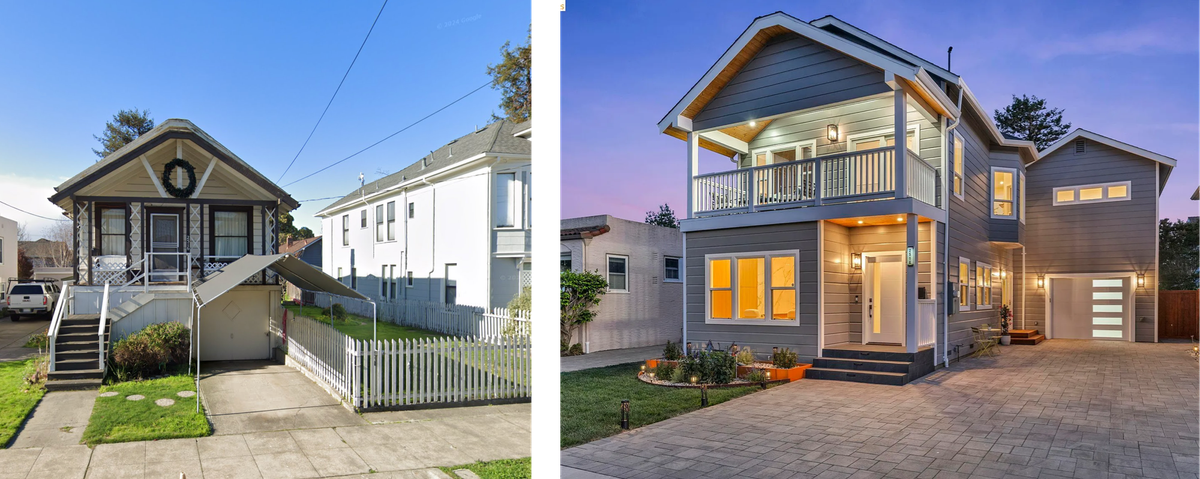
"You may have seen the construction over the past few years; now come and see the finished product" read the real-estate agent's flyer placed as an invitation by our front door this weekend.
We had seen the construction — it had been going on for multiple years just down John C. Calhoun Street. Beginning with an unfashionable cream color and dark brown trim, that house had its entire bottom removed, a new foundation built, the remainder jacked up toward the sky, and then expanded in all directions. Now it sports the paint scheme of most Alameda real-estate that's ready for sale: blue with white trim.
As I took photos of this construction over the years, and then as we went inside the finally finished house for an open-house this weekend, the question I keep wondering is why?
Why all of this involved construction to transform an aging structure into something completely different?
If the builders had wanted to build a "spec" house with such a futuristic chandelier over a staircase with glass railings; a wet bar with a wine fridge and a coffee-and-tea-making area for the upstairs family room; and Japanese heated toilets throughout the five bathrooms, then why hadn't they just knocked down the previous structure and built it from the ground up?
Or why hadn't they knocked down the previous structure and built two townhouses with the same level of taste and finish, perhaps just with a more modest number of bedrooms and bathrooms in each?
Why instead had they gone to such lengths to rebuild this structure that for a while it was in progress I though they were even going to preserve the old metal mailbox (which was affixed to the front railing and was being jacked up with the remainder of the main living floor)?
The reason for all that effort is that this is a historical house — pardon me, an historical house, guvnuh.
"the subject building was constructed in 1896"
Civilians like you and I may simply see an aging house that has served its purpose over the years and could be replaced with a new single-family house or a couple new townhouses — but to the Alameda Architectural Preservation Society, this is an 1896 structure with exposed rafter tails, clustered porch columns, and old-growth redwood siding – and therefore a matter requiring three pages of comment:
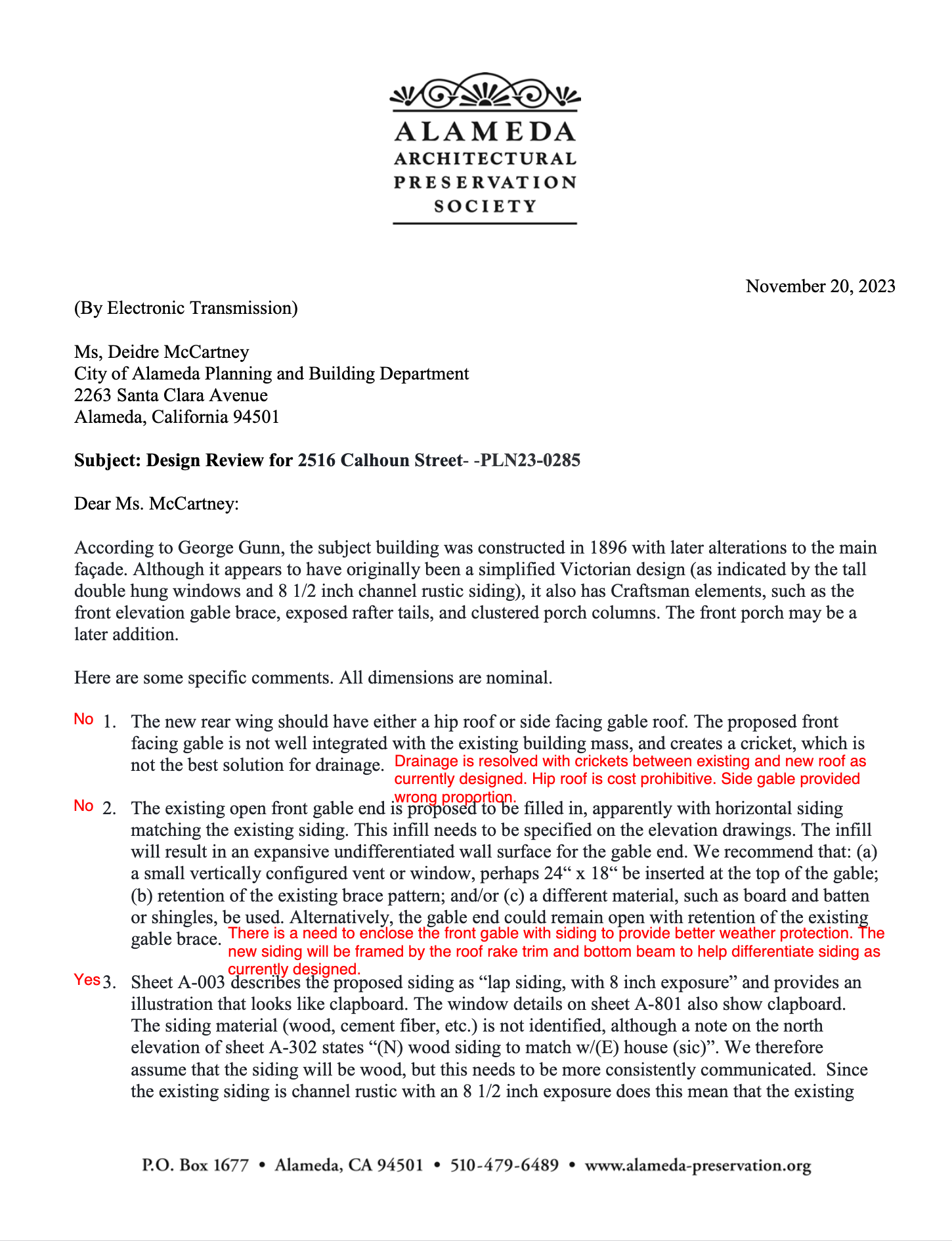
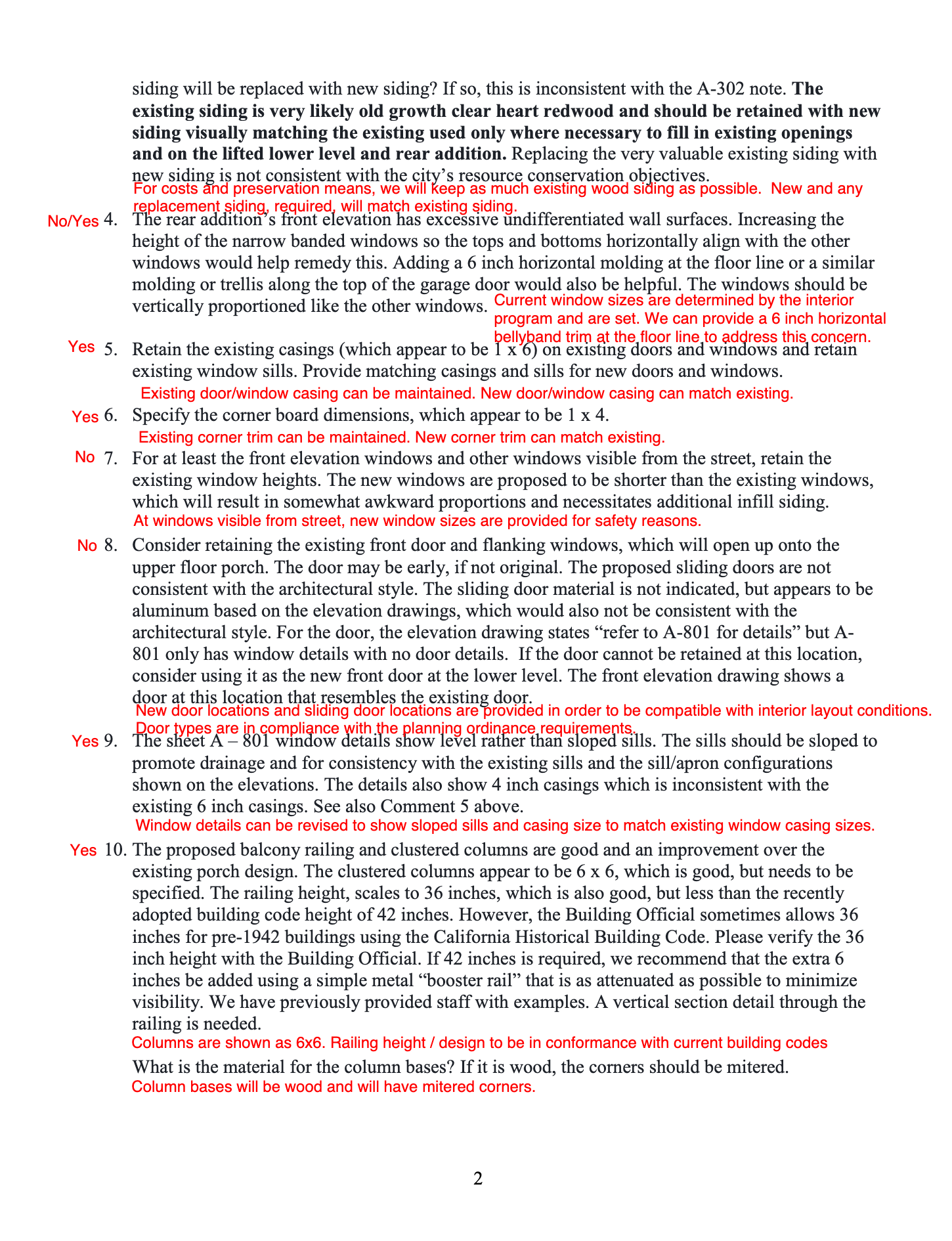
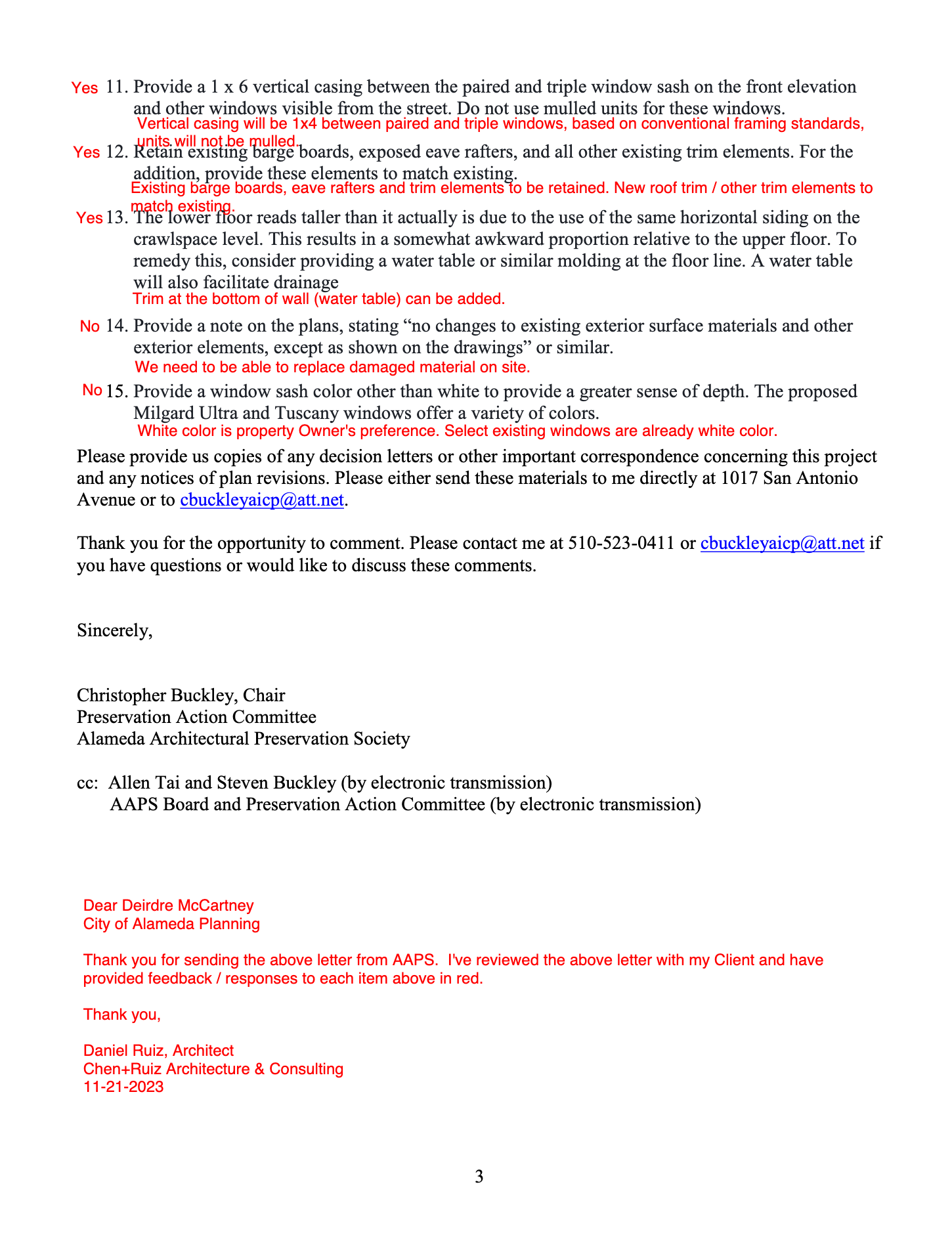
Comments from the Alameda Architecture Preservation Society submitted to the City of Alameda during the design review of 2516 Calhoun St.
The structure may be a muddle of architectural styles. It may have been altered multiple times over many decades. It may have no publicly noteworthy history attached to it to qualify for the city's list of historic monuments — but it is sufficiently old to be historical, and therefore is a concern of the Preservation Society.
While neither the city nor the property owner had to act on AAPS's three-page long letter in the case of this renovation, if the owner had instead sought to more simply demolish the structure and build a fully fresh structure, AAPS would have had a venue and an opportunity to oppose the proposed demolition. Per Alameda Municipal Code 13-21.7(a):
Any building that was constructed prior to 1942 shall not be demolished or removed without the approval of a certificate of approval issued by the Historical Advisory Board.
And per AMC 13-21.2:
Demolition shall mean the removal within a five (5) year period of more than thirty (30%) percent of the value of any designated structure or building, as determined by the Building Official.
HAB or HUB (Housing Unaffordability Board)
The Historical Advisory Board is five residents nominated by the Mayor and appointed by City Council to raise the cost of living in Alameda.
Well, no, that's not what's listed as the HAB's purpose on the relevant city website. And it's impolite of me to ascribe motive to the HAB's members who are simply volunteering on a long-established city board.
But let's be real: If you happen to own any house built before 1942 in Alameda, you're kind of stuck. If you try to start over with your private property, you'll have to get the approval of the HAB. The enthusiasts with AAPS will then likely write many more than three pages to oppose your demolition. Even if you succeed, there will still be a substantial time investment for the HAB meeting process and the cost of paying an architect to represent your interests, since by the HAB's bylaws, the members must have sufficient professional training to nitpick:
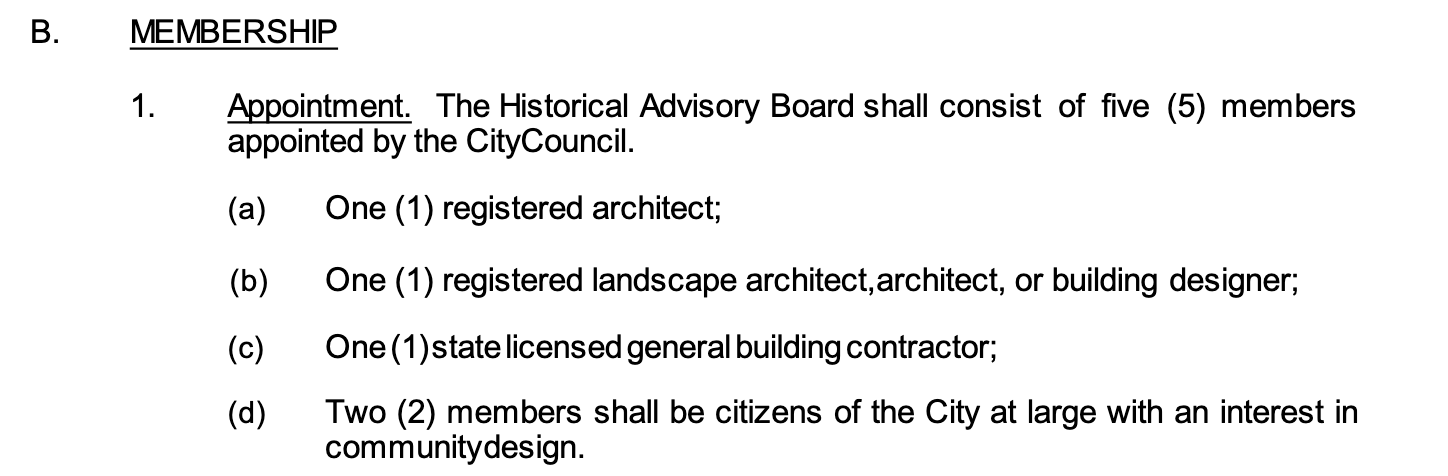
Instead of dealing with all that potential process and drama and whatnot, the owners of 2516 Calhoun St. decided instead to pay for multiple years of construction to lift and majorly alter the existing structure.
The results that follow:
- A 5,000 square foot lot will stay as a single-family house, even though there's enough land to potentially house multiple households and state law enacted by Senate Bill 9 could enable a lot split. The listing advertises "From the moment you arrive, you'll notice the spacious driveway offering ample parking—a rare find in this sought after neighborhood."
- After ~3 years of preparation and work, the house that was purchased for $900,800 is now being listed for $1,998,000 (and presumably the sellers are hoping for more.)
- The former entryway front porch is visually well preserved, even though AAPS wrote it "may be a later addition." Underneath the new paint may be some old growth redwood (although AAPS was probably speculating about that too).
Can Alameda afford these houses of Theseus? Yes, because there will most certainly be at least one household-buyer with the budget to eventually move in (thanks to our still relatively strong regional economy and high-paying jobs).
But is what's being "preserved" of genuine value to the Alamedans of today and tomorrow?
It's been preserved at the cost of three years' work, potential land for another household, and at least one million dollars. A private-property owner is certainly welcome to make that choice for themselves — this old-turned-new house does look quite glamorous on the inside — but when mandated and multiplied across the entire city, this sure looks like an unreasonably high cost for us to all collectively assume.