While you, like 19,081 registered voters in Alameda, may have turned in your ballot by yesterday afternoon, for those still with a ballot in hand, here are a few more questions and a few more answers regarding Alameda's Measure L:
Q. The Measure L website's FAQ says that Measure L will fund projects to "prevent flooding in the Tubes" — but aren't those tubes owned by Caltrans?
A. While the tubes themselves are owned and operated by Caltrans as part of State Route 260, water can reach the tube entrances through parcels owned by others. Particularly worrisome is the former rail corridor at a very low elevation.
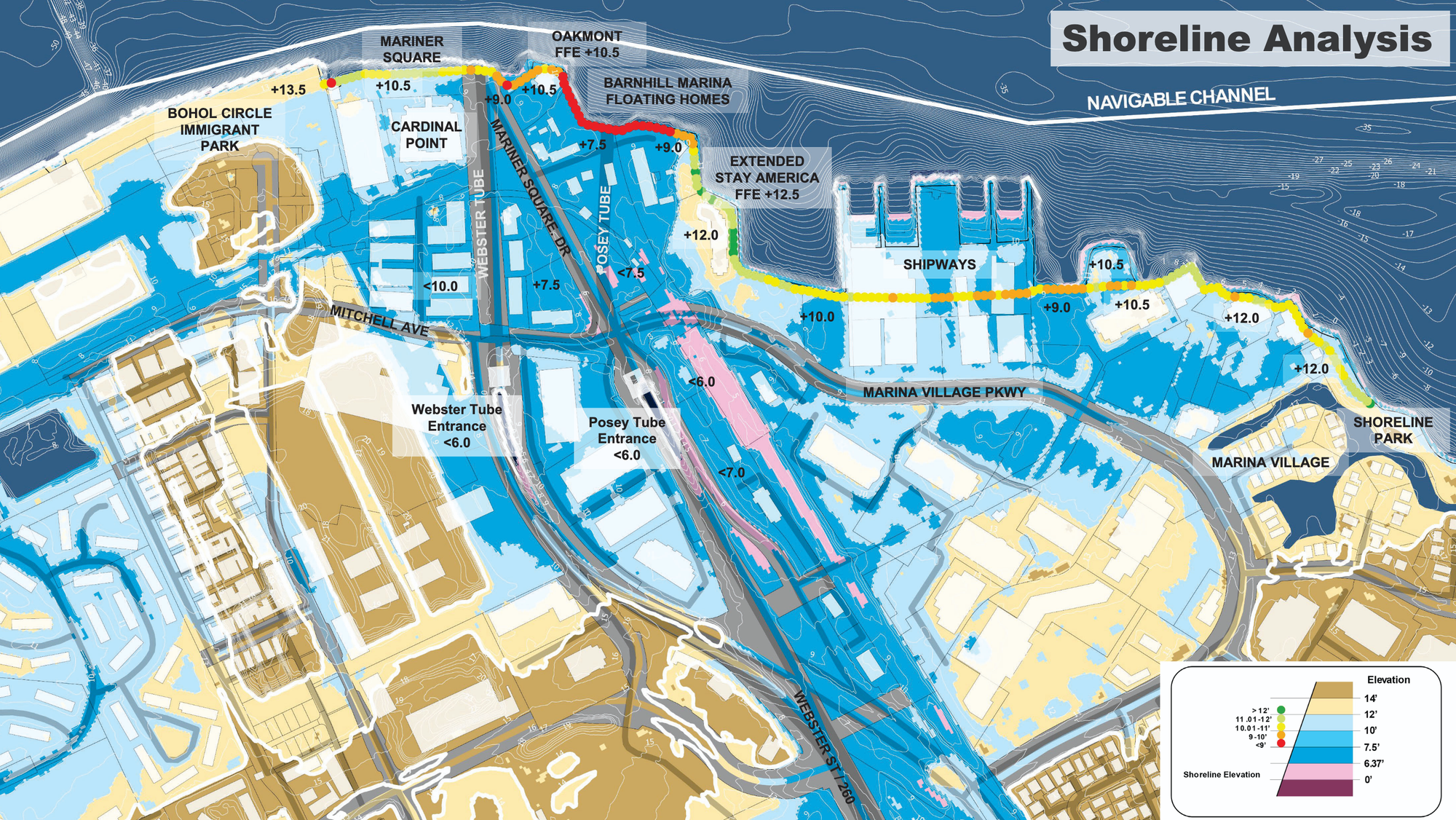
When I used to drop my kids off at preschool right next to this spot, more than once during winter I observed heroic efforts needed to pump rainwater out of the site of the REAP Climate Center — that's the pink area (effectively at sea level) near the center of this map:
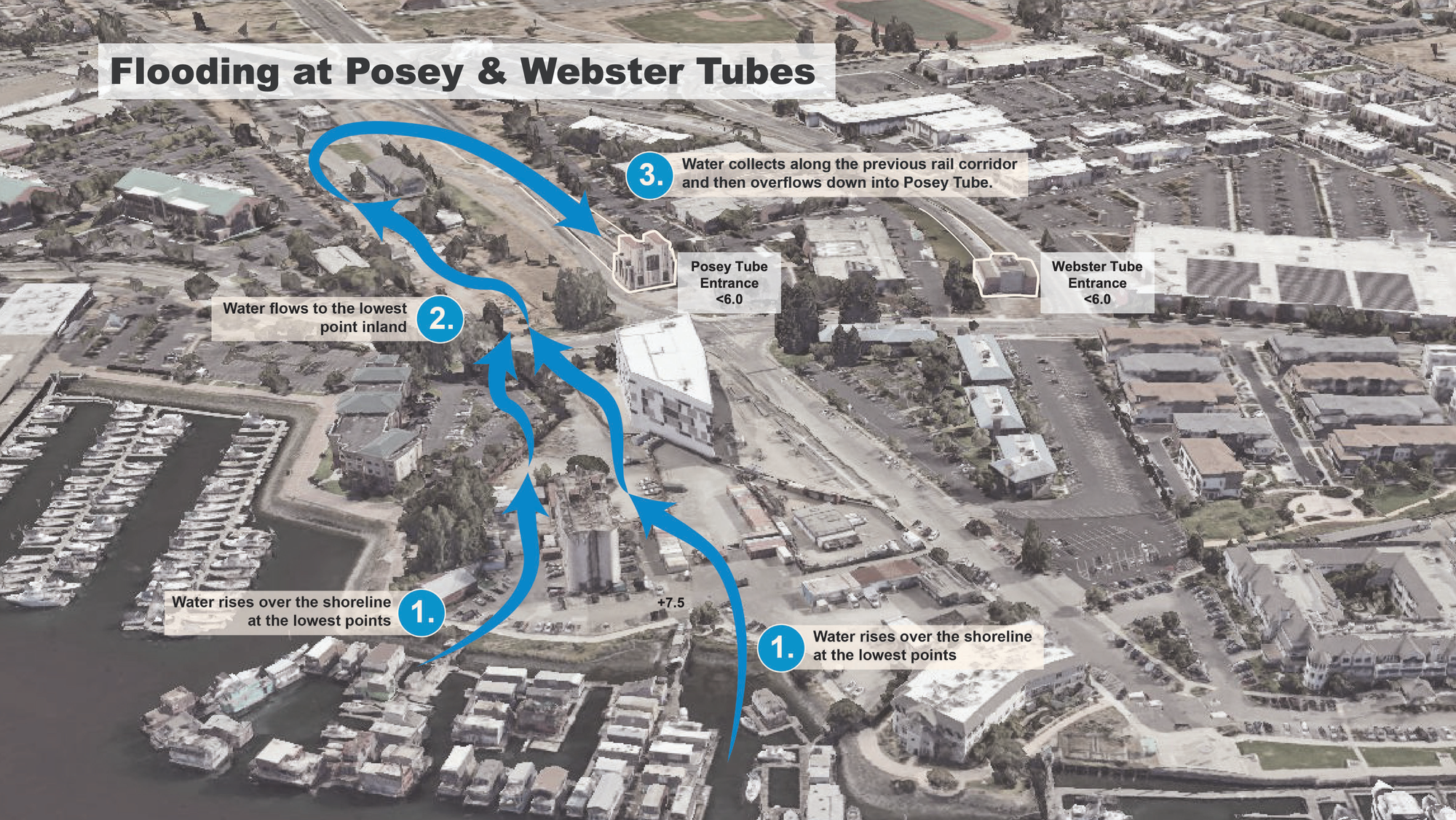
If tides are high and water overtops the edge of the island, it will flow to those lower elevations, hook around, and then flow directly into the Posey Tube:
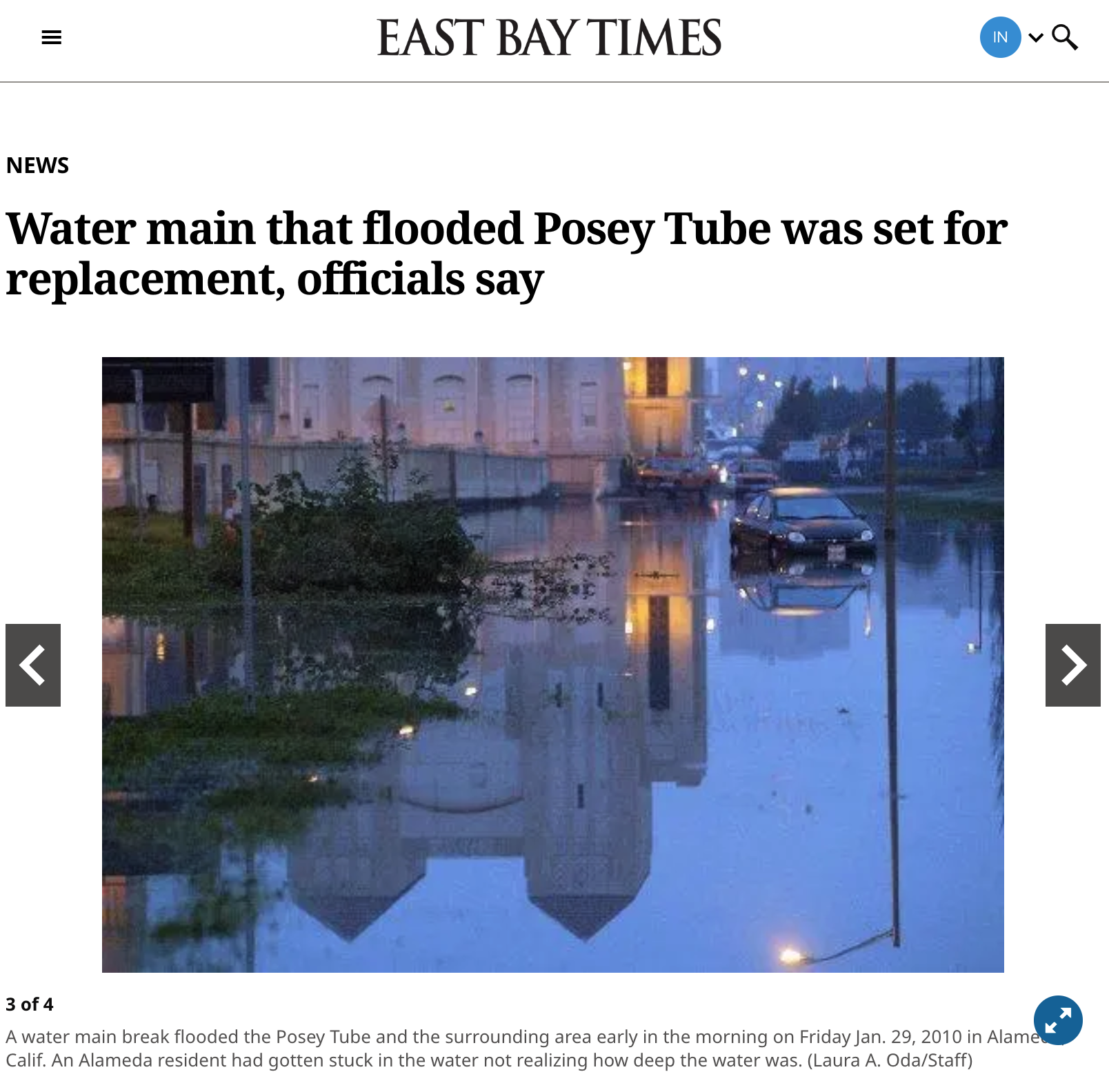
It doesn't take much water to shut down a tube. For instance, a burst water pipe sent water coursing down Webster Street in 2010, and Caltrans had to close the Posey Tube as a result:
Using a grant, Alameda has prepared preliminary designs for a combination of concrete-based and nature-based improvements to prevent water from overtopping the shoreline north of the tubes. Using city funds, Alameda has engaged another engineering firm to specifically study stormwater and pumping needs around Marina Village Parkway. Measure L would provide the capital funds necessary to implement these projects to prevent bay water and rainwater from threatening the Tubes, as well as protect surrounding businesses and residences.
Q. Why would Measure L also provide funds to renovate fire stations?
A. Here's a quick tour through Alameda's fire stations (excluding Station 3, which was built in 2017):
- Alameda’s Station 2 (right off Webster St.) is over 100 years old, and engineers expect several walls will need new foundations. Will it survive a large earthquake? I wouldn’t want to have to find out!
- Alameda’s Station 1 (right off Park St.) lacks sprinklers and a fire alarm panel. Its exhaust systems don’t work. Seems important for a building housing city staff around the clock!
- Alameda's Station 4 (on Bay Farm) has "signs of cracking and architectural damage in the concrete [and] recommended seismic strengthening includes installing holddowns where missing, add[ing] steel plates, welds and flange bracing at steel moment frames." Improvements ideally made before the next earthquake.
- In 2022, the World Health Organization’s cancer research agency classified firefighting as carcinogenic. While firefighters can’t avoid every exposure in the field, stations can be designed to keep those exposures from following them home: separate “dirty” and “clean” zones, diesel exhaust capture, and dedicated spaces to decontaminate gear and people. Older stations weren’t built this way. Measure L would make funds available to add proper decontamination areas to Stations 1, 2, and 4.
Q. Why is a potential new fire facility on the detailed project list?
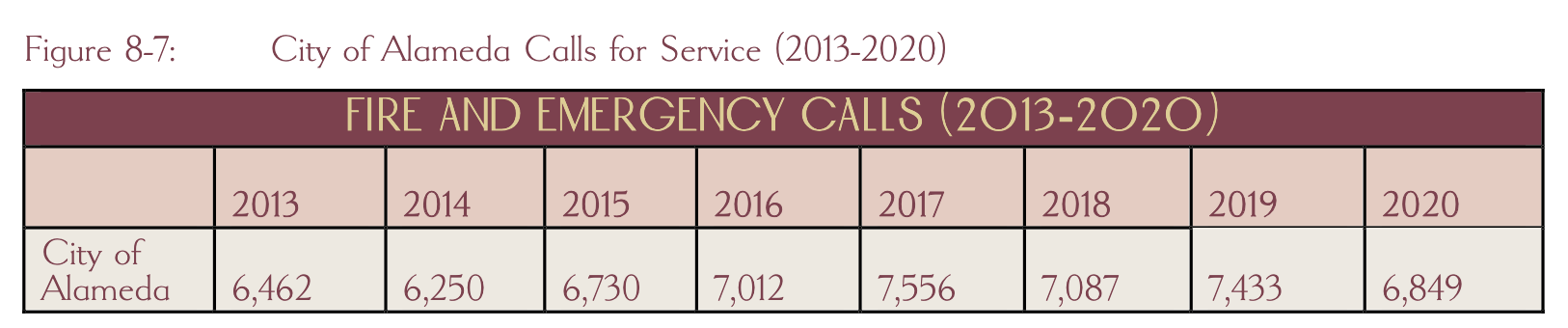
A. If you've lived here awhile, you may feel like you're hearing more sirens — you are. In 2013, Alameda Fire Department (AFD) responded to 6,462 calls, compared to 2025's 10,170 calls:
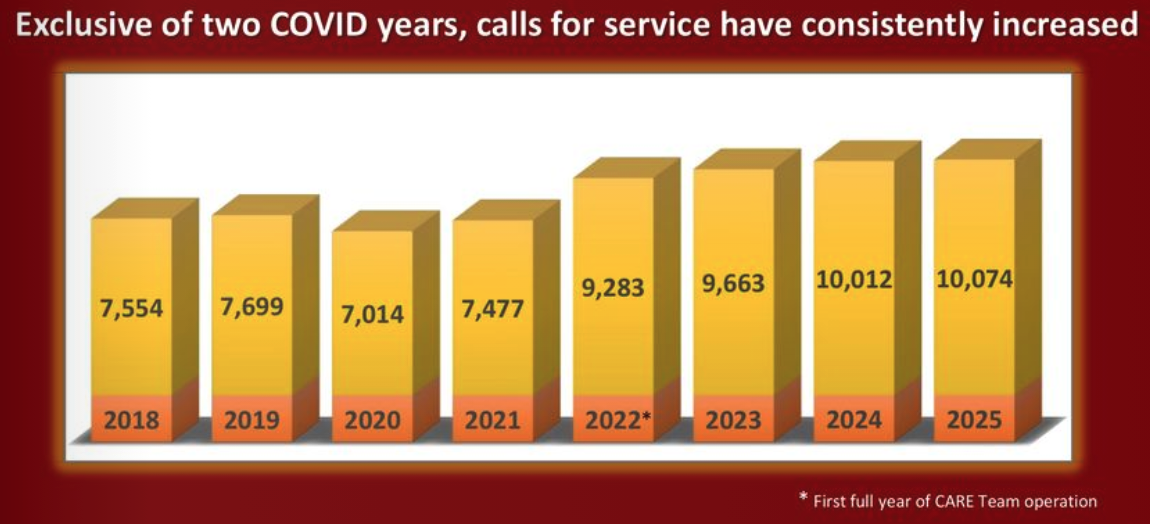
See this blog's post titled "Emergency coverage for a busy city" for maps showing how, with Alameda Point relying primarily on small, century-old Station 2 near Webster St., emergency response across the whole city can get stretched dangerously thin on busy days
Alameda maintains a Class 1 ISO rating. (That's not the abbreviation for the "International Organization for Standardization" — it's actually the abbreviation for the "Insurance Services Office.") The better Alameda's ISO rating, the lower our homeowners and renters insurance.
Currently Alameda has the highest possible ISO rating; however, the consultants who prepared Alameda's recent "Community Risk Assessment: Standards of Cover & Deployment Analysis" determined the city may not be able to hold onto this ISO rating as service calls and Alameda Point's population increase. If that happens, it may raise our individual insurance costs. Personally, I'd much rather band together to pay for sufficient coverage to maintain rapid emergency response across the entire city and keep our homeowners insurance comparatively lower.
Q. How would Measure L help to fix Alameda's streets?
A. In April 2025, the Transportation Commission learned Alameda is no longer able to pay from existing revenue sources for Alameda's standard annual repaving program. The overall costs of construction services are up (by upwards of 40%!); the specific inputs of petroleum for asphalt have increased in cost even more; and more people are driving EVs, lowering gas tax revenues. Therefore, to continue with the basic planned repaving, City staff proposed tapping the General Fund and City Council approved that for the current two-year fiscal year cycle.
If voters pass Measure L, then a new source of funds for repaving and pothole repair will be available. The Measure L bond will be able to increase the transportation capital budget sufficiently to tackle the worst of Alameda's streets that need full re-builds (for instance, Harbor Bay Parkway, which cannot be repaved using the current annual funds) and to also curtail this new reliance on the city's General Fund, freeing those funds to return to other operational priorities.
Measure L's detailed project list enables funds to be used for repaving projects, combining together both paving fixes for motorists and basic safety features for pedestrians and cyclists. (Larger corridor-level projects, such as the recent redesign of Central Ave, will continue to be primarily funded via other city funds and external grants.) Measure L will not change or decrease the public input process for paving projects.
Q. Is there organized opposition to Measure L?
A. Councilmember Tony Daysog is the sole author of the argument against Measure L. You can find it in your voter information guide.
He also formed a campaign entity to oppose the measure; that entity has yet to report any expenses or in-kind contributions. His rebuttal in the voter information guide directs readers to welovealameda2026.com for more information, but it's currently an empty website.
While his arguments have varied, Councilmember Daysog has been consistent in his opposition to the idea of locally controlled capital funds for local infrastructure:
- In 2026, he voted against moving Measure L to the ballot.
- In 2024, he voted against moving an infrastructure funding measure to the ballot.
- In 2022, he voted against polling to assess the feasibility of an infrastructure funding measure.
To be clear, even if some arguments against don't entirely hold water, Measure L must genuinely earn the votes of Alamedans to pass and to succeed.
Q. Who has gone above and beyond in their support of Measure L?
A. After ballot counting is complete, whether or not Measure L passes, this blog will have many individuals and many organizations to thank.
In the meantime, special acknowledgement to Malia Vella and Thushan Amarasiriwardena. Though both have been so busy on their own respective campaigns for mayor and council, they have still found more time in their days to provide substantive support for Measure L. Just as Jerry Brown in his second tour of duty used all available election cycles to deploy his political capital to support critical ballot measures, their leadership speaks not just to winning an election but also to fixing problems that will outlast any one term.
Q. Measure L is promising a lot. Can it deliver?
A. The city's consultants have identified approximately $800 million of outstanding needs in Alameda's shorelines, streets, stormwater systems, and public facilities. Measure L would enable the city to raise $300 million via the sale of general obligation bonds.
Regarding that gap between $300 million and $800 million: City of Alameda staff already do an excellent job of applying for grants from the county, the region, the state, and even the federal government — these programs almost always require a local match. Measure L provides that local match for even more grant applications. Alameda may be able to cover 70%-80% of some of the most critical projects through external funds, with Measure L covering the remainder. These funding opportunities come up unexpectedly, so having just enough flexibility with local-match funds will enable the City to maximize the external funds applied for, shooting for that overall ~$800 million target.
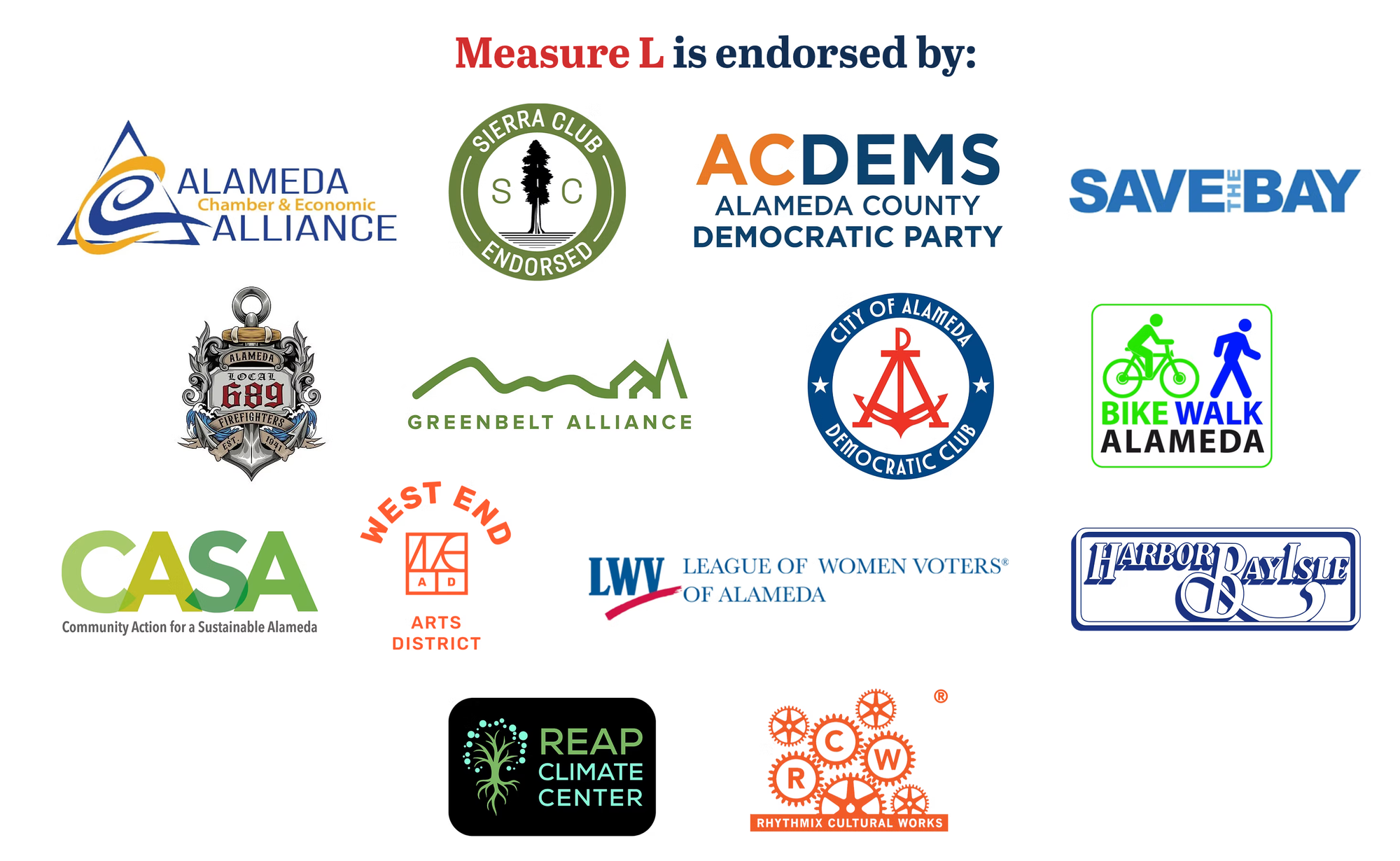
Regarding a potential gap in trust: Besides the hard numbers, there's a more amorphous question of trust. Over the past few months I've had coffee after coffee and call after call with a wide range of stakeholders about Measure L. While only one local stakeholder who will go unnamed got so livid that he hung up on me, many more residents, business owners, and non-profit and civic leaders have been kind and candid — they've shared both their support for our city and also their open concerns. I've genuinely appreciated deep conversations with the organizations who have chosen to endorse Measure L:
To address concerns proactively, the text of Measure L builds in accountability mechanisms:
- all funds go to capital projects
- no funds may go to pensions
- an annual report by the City's Finance Director on both fund usage and project status
- a citizens' oversight body
- all contracts to be heard and awarded publicly by the City Council
The goal isn't simply to pass Measure L — the goal is to pass Measure L and to use Measure L to deliver real results for Alameda with fiscal prudence, transparency, and swift execution.
The rain's coming. Let's put on our collective raincoat.
More Q&A re L
Alameda's Measure L, on today's ballot, would fund fixes for our most pressing infrastructure problems